

Successful completion of the large-scale pilot DC4EU
 Some of the members of the EMREX community have taken part in the EU-funded large-scale pilot DC4EU (https://www.dc4eu.eu). The project finished successfully at the end of July 2025.
The aim of the project was to create a working pilot installation of a digital wallet that conforms to the EUDI wallet framework and do piloting tests in large scale.
The EMREXians participated in two development tasks, one to create an EMREX gateway to the wallet and the other to create conversion possibilities between the two data formats, ELMO and ELM. The converter can do the conversion both ways, from ELMO to ELM and also from ELM to ELMO. This way the wallet can transport educational data between any parties, not limited to higher education institutions. All results of the project are public domain and available to anyone. It is assumed that the results will be put in use when the national EUDI-wallets become more readily available.
In the later parts of the spring piloting activities took place. The project tested two different wallets, one web wallet based on wwWallet and one native app based on EBSI. Piloting was successful in both cases.
Strategic Advisory Council inauguration meeting
In the MoU it has been agreed that a Strategic Advisory Council (SAC) should be founded. This council will provide expert advice, guidance, and support to the EMREX User Group on long-term strategy, partnerships, sustainability, and global engagement. The signatories of the MoU members will take place in the council. The first (online) meeting was held on the 6th of October, 2025 with the main objective to agree about the final version of the MoU. The next meeting was held on the 1st of December 2025 and both forms of collaboration and what issues to focus on was discussed. It was decided that the EC would research different options and report at the next meeting with the SAC in end of January. The EMREX EC wishes the SAC good luck with their new positions, and we sincerely hope that together we’ll make the EMREX network future proof and even more successful.
The website will be updated with information about the SAC.
GDN annual meeting in Oslo and signing of the EMREX MoU
The Groningen Declaration Network (GDN) held its annual meeting in Oslo at the end of October 2025. This year’s theme was Working for a better tomorrow together. It is a truly world-wide organization with participants from all continents of the world. A lot of discussion was about recognition and not only the technical possibilities to transfer results for recognition but also on the actual process of recognition and the acceptance of foreign credits. EMREX was part of some presentations but the networking possibilities are of equal importance.

GDN meeting in Oslo
At the conference three organizations signed the EMREX Memorandum of Understanding (MoU) together with three organizations online. The core objective of the MoU is to formalize obligations and agreements between current full member organizations and by so strengthening the network for future developments. The MoU has been signed by the following organizations:
- Dienst Uitvoering Onderwijs (DUO) located in the Netherlands,
- Sikt – Norwegian Agency for Shared Services in Education and Research located in Norway,
- CSC – IT Center for Science Ltd located in Finland,
- The LADOK consortium representing all Higher Education Institutions in Sweden,
- The Agency for Science and Higher Education (ASHE) representing Higher Education Institutions located in the Republic of Croatia,
- MUCI (University Centre for Informatization) representing Higher Education Institutions in Poland gathered in MUCI consortium.
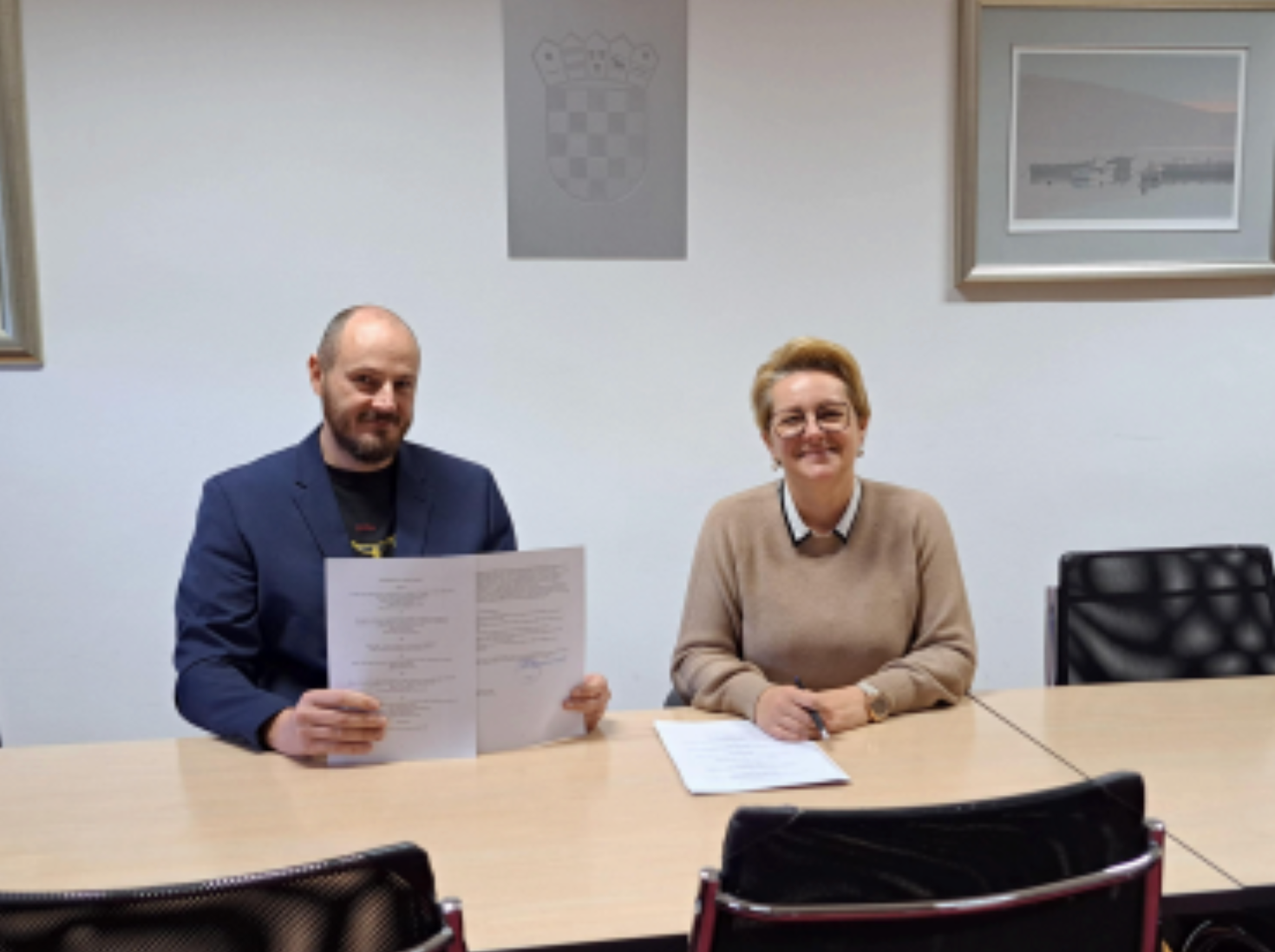
GDN meeting in Oslo – Croatia signs EMREX MoU (Igor Drvodelić, Danijela Horvatek Tomić)
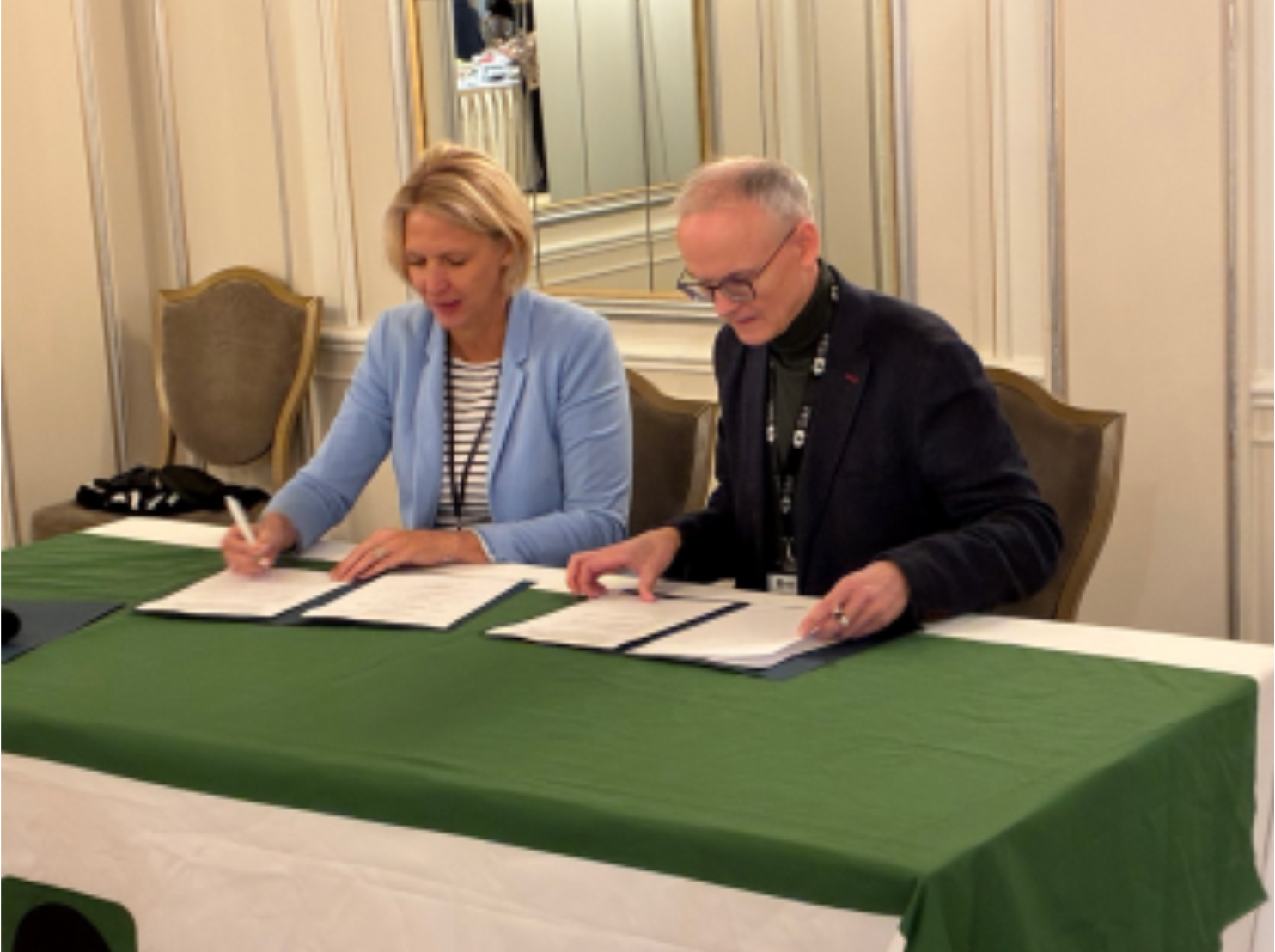
GDN meeting in Oslo – Norway and the Netherlands signs EMREX MoU (Anke de Jong, Geir Vangen)
Once Only event in Zagreb
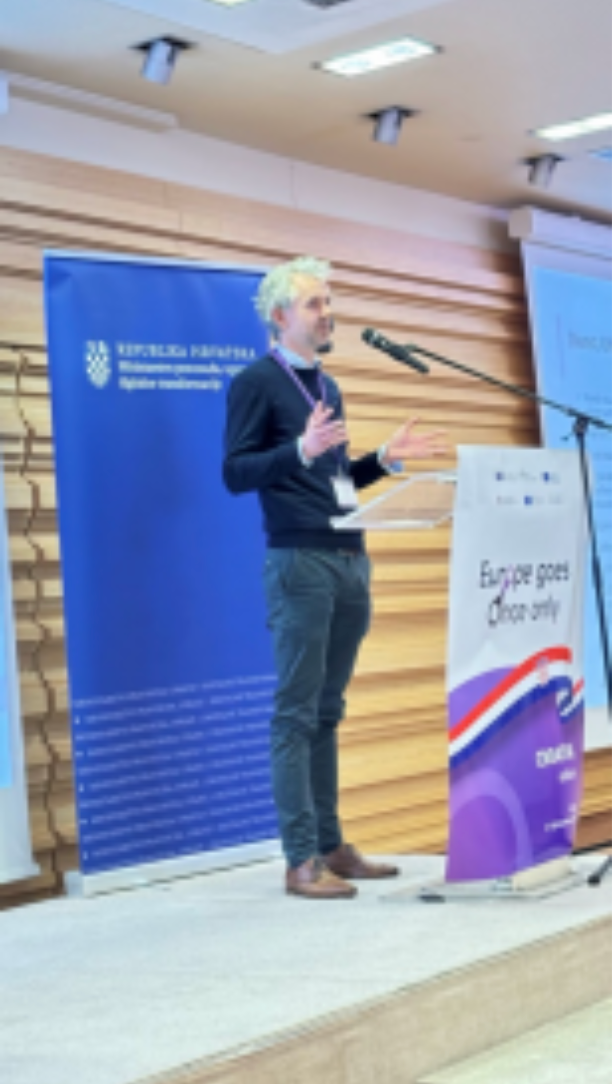
The Europe goes Once-Only event series accelerates the on-boarding of national competent authorities to the Once-Only Technical System (OOTS). It brings experts working on Once-Only from all over Europe directly to the Member States to discuss, learn and overcome challenges together.
Europe goes Once-Only – Croatia edition brought together competent authorities connecting to Once-Only with the national and Commission teams implementing this system. From the EMREX network both DUO and ASHE attended and presented their plans of how to connect to OOTS.
At Zagreb DUO and RINIS presented their achievement of the EMREX OOTS bridge getting to level 6 of the accelerator meter.
This means that, conforming to OOTS project levels, the bridge is fully in production and ready to exchange real life transactions. This is a great achievement for the EMREX network and the OOTS project. The strength of both networks together truly makes student and work mobility possible between all EU member states. Other EMREX countries are considering connecting as well, hopefully in 2026.
At the Panel discussion Implementing OOTS at home and in your neighbourhood, representative of the ASHE described the advantages of using the EMREX bridge and the ELMO standard in the OOTS environment.
Another great achievement was mentioned by the host of the event, Croatia. 19 of 21 procedures are now at level 6 (accelerator meter) making them one the most successful countries within the project.
Unconstrained by Legacy: A Cutting-Edge Case Study for Global Interoperability
by Koichi Nakasaki, Chief Research Officer, The Institute for Future Engineering, k.nakasaki@ifeng.or.jp
Unlike EMREX member countries, which have been advancing the digitization of educational records at the national level since the 1990s, Japan has operated with a notable absence of digitisation efforts. As recently as 2020, none of Japan’s nearly 800 universities were issuing macro-credentials in digital form.
The turning point came in 2022, when I conducted research commissioned by the Ministry of Education, Culture, Sports, Science and Technology (MEXT) and published a paper that (1) advocated for credential digitization with a focus on international interoperability and (2) recommended a market-driven approach, encouraging voluntary initiatives by individual institutions.
Building on this, an implementation guide was published, and seminars and other awareness activities were offered.
These initiatives appear to have delivered tangible results – a number of new products were introduced in quick succession by several Japanese IT firms over the past 12 months. This emerging “market dynamic” was notable for the fact that it was not orchestrated by any central body; rather, it evolved organically in response to user needs and competitive pressures. Moreover, as this trend is largely unconstrained by legacy systems and convention, it could serve as a unique, cutting-edge case study illustrating how global interoperability can evolve organically.
This article focuses on case studies of products launched over the past 12 months by five promising Japanese IT companies: JAST, Uchida Yoko, NetLearning, NTT West and Fujitsu, each holding a market share between 10% and 25% in the Student Information System market or the OpenBadge platform segment for Japanese universities. Some of these new products offer distinctive features, including interfacing with LinkedIn, the National ID app, and full integration within student portals. While these aspects are noteworthy, this article focuses instead on issues related to global interoperability, as summarized in the table below.
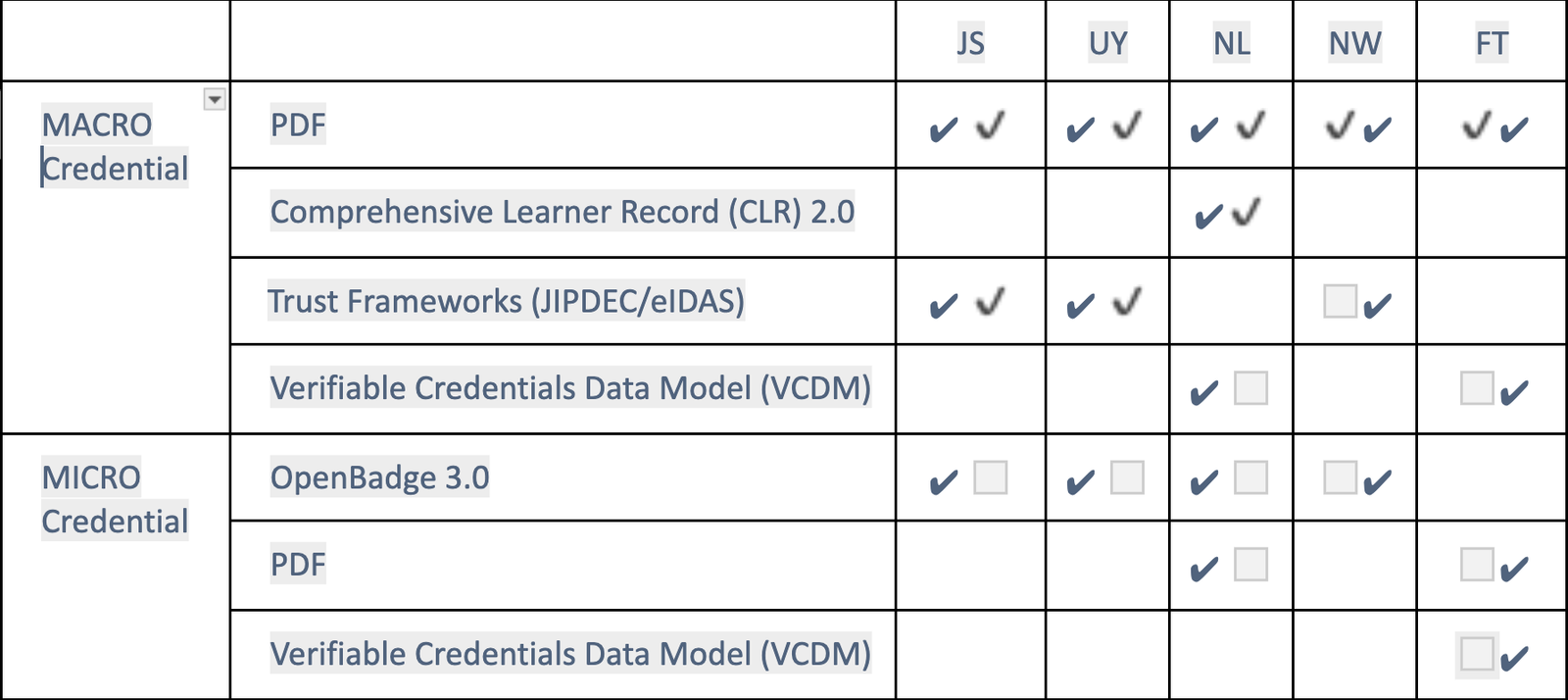
Table 1: Interoperability in Recently Launched Products by Five Japanese Vendors¹
The table indicates that PDF is employed by all five vendors as the presentation format for macro credentials, with two vendors extending its use to micro-credentials. User feedback confirms that continued reliance on PDF is driven by high acceptability from validators (receivers). PDF’s universal usability and portability mean that the network effects of existing adoption strongly persist even as more dynamic formats emerge.
Furthermore, CLR 2.0 constitutes the sole data model adopted for macro-credentials in this context, with no evidence of PESC, ELMO, or alternative legacy formats. This exclusive adoption is primarily driven by educational institutions’ desire to select a future-proof data model for their initial investment. As latecomers to digitisation, they are unburdened by decades-old systems and highly motivated to choose CLR 2.0, which stands out as the most promising and modern standard compared to older alternatives. This ‘greenfield’ approach indicates a clear market preference for modern data architecture over fragmented legacy XML formats.
¹NOTE: Based on publicly available information and vendor interviews. Interpretations and conclusions are those of the author. Vendor Abbreviations: JS: JAST, UY: Uchida Yoko, NL: NetLearning, NW: NTT West, FT: Fujitsu. Vendors are listed in descending order of estimated market share percentage.
With respect to trust frameworks, JIPDEC—an eIDAS-compatible framework, following the mutual recognition agreement between Japan and the EU concluded at the end of 2023—and VCDM appear as alternative approaches, adopted by three and two vendors respectively. While these frameworks may initially seem competitive, their underlying rationales diverge: eIDAS adoption is primarily institution-driven, whereas VCDM reflects a technology-driven orientation. Therefore, this divergence suggests a potential for convergence, such as enabling VCDM to function technically under the legal framework of eIDAS/JIPDEC, rather than simple competition.
To draw implications from this case study that could be relevant to global interoperability, I compare it with a global best practice model that I introduced three years ago at the GDN Network Annual Meeting in Groningen and which was included in a paper published last year2. The interoperability component of that model posited that PDF digital signatures would remain the most widely adopted interoperability framework, while VCDM would emerge as a pathway for converging fragmented data formats.
However, the case study reveals several deviations from the expectations set three years ago. Specifically, VCDM’s penetration has progressed more slowly than anticipated, whereas OB 3.0 and CLR 2.0—both VC-compatible—have achieved more rapid uptake than native VC implementations.
Another deviation is that PDF has consolidated its position as the dominant human-readable presentation format, consistent with earlier projections, although the fact that the majority of adoptions did not incorporate digital signatures was totally unexpected.
Taken together, and in conclusion, the Japanese experience may illustrate a possible future for global interoperability, characterised by the following elements:
- PDF as a human-readable presentation format.
- CLR 2.0 as the underlying data structure.
- eIDAS, JIPDEC, and other compatible or mutually recognised trust frameworks for institutional trust.
- VCDM as a technical trust framework.
This proposition is further reinforced in light of the globally shared ultimate goal of interoperability, as advocated by the Open Recognition, which seeks to articulate informal, semi-formal, and formal recognition across micro, meso, and macro contexts. This is supported by the following considerations:
- The universality of PDF makes it suitable for informal and semi-formal recognition.
- The structured nature of CLR 2.0 supports learners in organising their learning pathways.
- Trust frameworks help prevent fraud across informal, semi-formal, and formal recognition — technically through VCDM and institutionally through eIDAS and its mutually recognised frameworks.
I hope that this market-driven, “greenfield” approach presented in Japan’s case study can serve as a useful reference point for ongoing discussions on student portability and life-long learning within the EMREX and broader ecosystem.
²Published by the GDN Network, titled “Creating Interoperable Networks and Systems” (August 2024). Available here.
Get in touch
EMREX portal is available at emrex.eu. To contact us write to info@emrex.eu. To get support write to support@emrex.eu.