Norwegian Diploma Registry (Vitnemålsportalen)

(by Jan Erik Johansen, PO in Unit for Vitnemålsportalen)

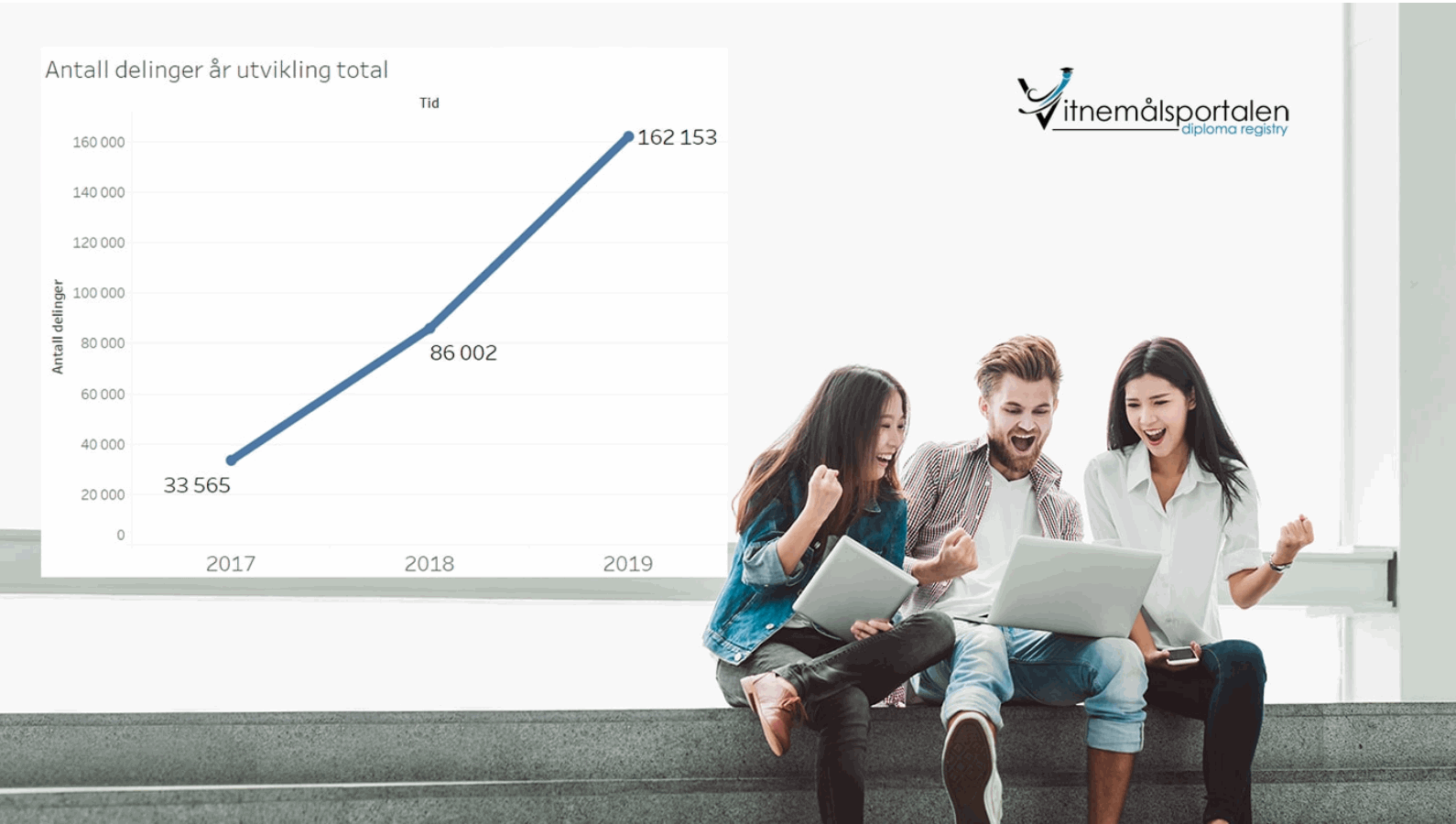
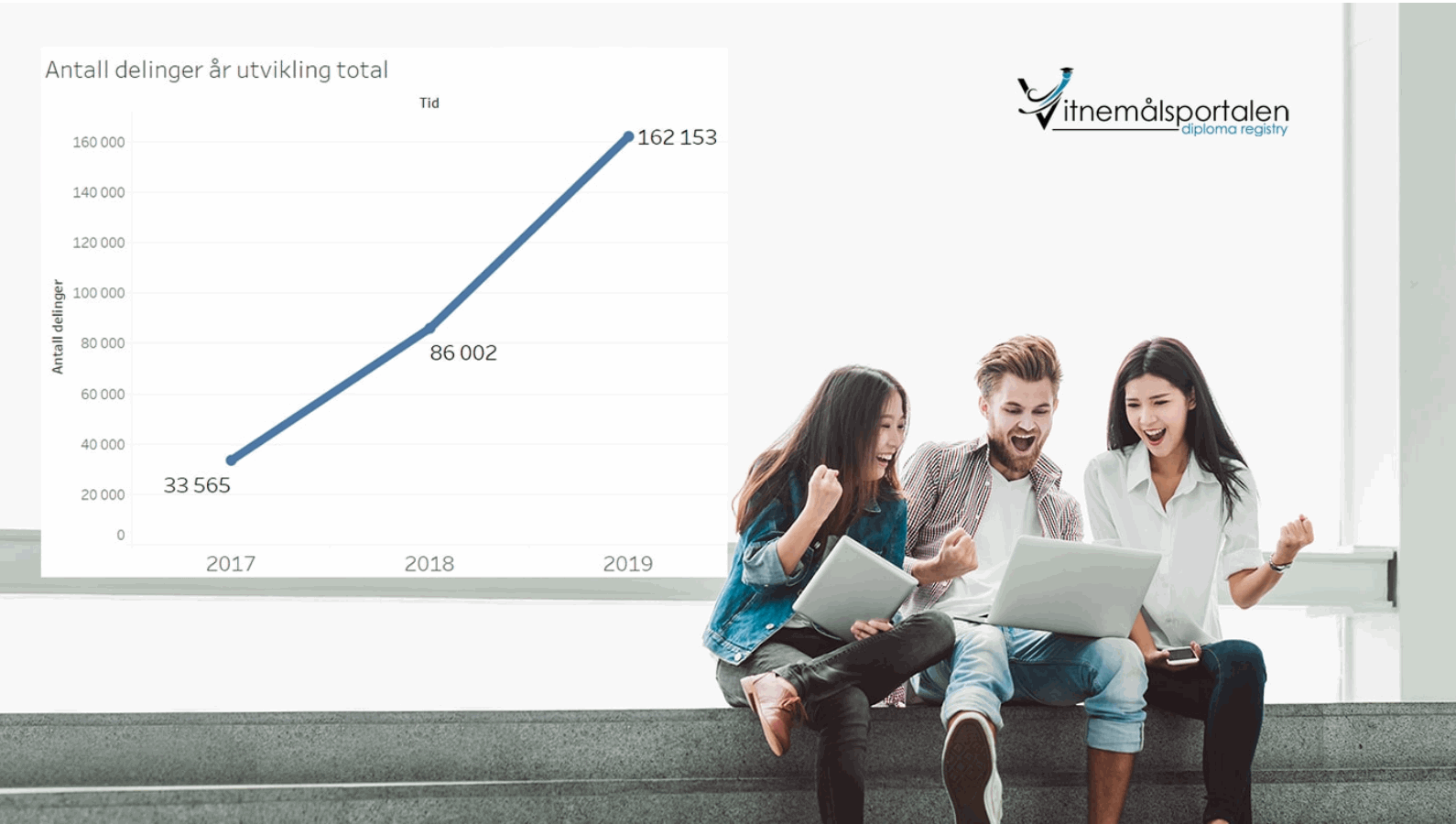
The Norwegian Diploma Registry (Vitnemålsportalen) has seen a large increase in the sharing of educational results via EMREX in the last year. The number of EMREX sharings doubled from 2019 to 2020, from 28 000 to 57 000. The reason for this has been the growing number of web services connecting as EMREX clients to the Diploma Registry the last couple of years, especially recruitment services.

Regular sharings of higher educational results are also on a steady rise, with 71 000 in 2018, 133 000 i 2019 and 164 000 in 2020.

The Diploma registry is a Norwegian service established in 2017 by Unit – The Norwegian Directorate for ICT and Joint Services in Higher Education and Research, commissioned by the Norwegian Ministry of education and Research.

The main goal of the Diploma Registry is to help individuals collect their results from higher education and share them with potential employers, educational institutions and other relevant recipients. The sharing is easy, safe and 100% digital. The use of the Diploma Registry is free of charge.

Since 2017 logins have nearly doubled year over year, with almost 600 000 in 2020. The Diploma Registry is now an established resource among the whole of the population, not only young people in an ongoing education.

Unit is in the process of expanding the scope of the service with other kinds of education, knowledge and skills, e.g. vocational schools, professional certificates, language tests, driver’s licences and more.

More information about the service can be found at https://www.vitnemalsportalen.no/english/.

EUNIS Students Mobility Task Force promotional video

EMREX Newsletter, September 2020


Table of Content

Annual Assembly Welcome Message from new Chair EMREX Executive Committee 2020-2022 EMREX Statutes Vietsch Project Germany‘s digital certificates using EMREX DAAD-conference The ECCA report The EDSSI project Expected activities Get in Touch

EMREX Annual Assembly June 15th 2020

The most important event for EMREX this year was the General Assembly which took place on June 15th, a week after the online EUNIS congress. As most events this year it was not an ordinary meeting, because it was held entirely online. The meeting gathered 23 participants from 12 countries, including China and Japan. The meeting went surprisingly well and the ongoing pandemic would certainly set a new standard for the need of business travel. The agenda covered the usual items, like yearly report from the Executive Committee, plan for the current year and usage statistics from the running NCPs but also other items. The last year’s Annual Assembly identified a need to update our statutes. The Executive Committee worked on this during the year and a new suggestion was introduced and accepted. The main differences are a simplified application procedure and an improved voting procedure. The updated statutes are presented in another section of this newsletter. Another important issue on the agenda was, next to yearly report and forecast for 2021, the election of all the positions on the EMREX Executive Committee. See separate section on this. New members were proposed and accepted at the meeting. We warmly welcome the following new members! Full members: • Georg-August-Universität Göttingen (Germany). Associate members: • Universidade Lusófona de Humanidades e Tecnologias (Portugal), • Freie Universität Berlin (Germany), • AVOHOKS (Higher education organization in Flanders).

Welcome message from the new Chair Tor Fridell

At the general assembly in June I was elected as Chair of the EMREX user Group Executive Committee. It is a great honour especially since I come after Jan-Joost Norder who has done a magnificent job as Chair. Many thanks for the work Jan-Joost! I would like to share a few words about myself. I am employed at Linköping University where I work as Operations manager and Head of Student Information System. I have however a long history working for the Swedish Ladok Consortium, which develops, operates and maintains the Student Information System Ladok. This Consortium now consists of practically all higher education institutions in Sweden and this is not by law or force but because the product meets the needs of the members so well that they all have joined voluntarily. All HEIs influence the development and all actual requirements gathering is done by individuals from the member universities, like me. Even the development is done by a university – Umeå University. With this said about me I look forward to lead the work of the Committee. Some of us have been in the Committee for a while but we have one new face, Igor Drvodelić from AZVO in Croatia. I like to give a special welcome to Igor! Tor Fridell Chair of the Executive Committee

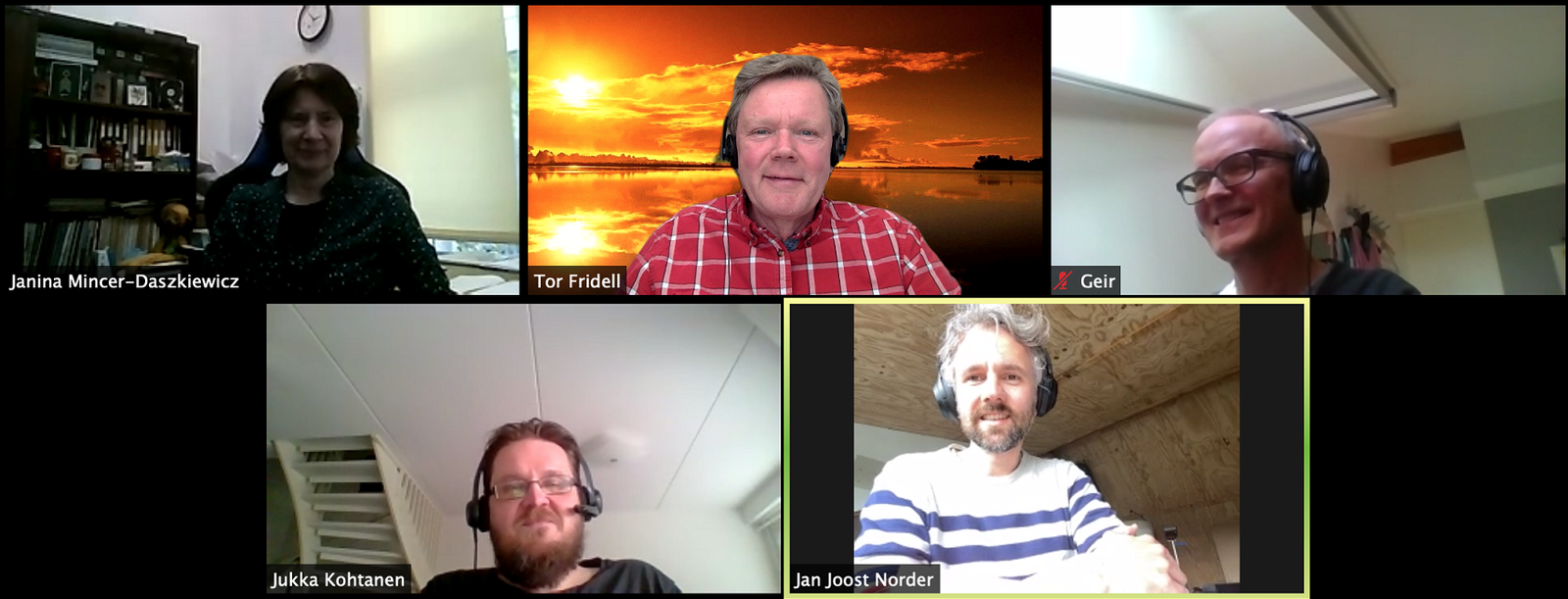
The EMREX Executive Committee for the period 2020-2022 (from the top left: the Netherlands, Sweden, Finland, Norway, Poland, Croatia)

EMREX Executive Committee for 2020 – 2022

The new Executive Committee, elected at the EMREX General Assembly, has a strong presentation of technological, educational and business insight and gathers people who offered their time for keeping the EMREX running. The Executive Committee of EMREX for the period 2020-2022 consists of the following members: • Tor Fridell from LADOK (Sweden) – chairperson, • Geir Vangen from UNIT (Norway) – vice chair, • Jukka Kohtanen from CSC (Finland) – secretary, • Jan-Joost Norder from DUO (Dienst Uitvoering Onderwijs, Netherlands), • Janina Mincer-Daszkiewicz from the University of Warsaw (Poland), • Igor Drvodelić from AZVO (Croatia).

EMREX Statutes

The EMREX network having been growing and the service becoming more established and the Executive Committee recognized last year a need to revise the EMREX statutes. The goal was set to making it easier and clearer to join the network and encouraging creating value to the network. The proposal for the new statutes was sent to EMREX members with a request to deliver comments and questions to the Executive Committee. The revised statutes were then proposed, discussed and approved at the Annual Assembly meeting. The main changes in the statutes are as follows: • All full members have voting rights and at least one vote. Full members get an additional vote for providing data for secondary level education. Countries running EMREX registry (EMREG) get an additional vote. Thusly, one member can have a maximum of three votes whereas in the previous statutes only one vote per country was permitted. • New full members are approved by a vote of the current full members. There is no requirement to confirm the memberships at the Annual Assembly. • The Executive Committee has the right to remove any NCP’s from the EMREG that have not been functional for one month. The NCP can be reinstated when the NCP is functional. The new EMREX statutes can be found here: https://zgfreestyle.hr/emrex/wp-content/uploads/2020/09/EUG_Statutes_2020_final.pdf.

Vietsch project

The EMREX Executive Committee applied for a project funding from the Vietsch Foundation and in June we got good news – the application was successful! The project consists of two parts: • Industrializing the EMREX Registry and reviewing the ELMO standard, • Dissemination of EMREX services and building the EMREX brand. The first part is scheduled to finish by December 31st 2020 and it contains on-line conferences and developing ELMO format. In addition, new and potential members are supported by providing technical help. The expected outcomes are technical specification of the new EMREX registry and specification of the new ELMO version. The second part ends on June 30th 2021. It has several goals: • organizing stakeholder seminars, • preparing the final ELMO specifications, in the format required by future development, • visiting national meetings of new members, • participating in international conferences to disseminate and build EMREX brand. Naturally the activities in the second phase are affected by the COVID-19 situation. Additional information can be found here: https://www.vietsch-foundation.org/2020/08/05/emrexproject/.

Germany‘s digital certificates using EMREX (by Guido Bacharach, Head of Strategy and Digitization Unit, Stiftung für Hochschulzulassung)

The first prototype for digitally authenticated and machine-readable certificates in Germany is running and successfully using EMREX. In cooperation with the ministries of the federal state of North Rhine- Westphalia (NRW), various German universities and the Stiftung für Hochschulzulassung (SfH), the German Bundesdruckerei (BDR) has succeeded in creating a first fully functional prototype for authenticated and machine-readable certificates. The concept of this prototype is based on the White Paper of the German Network for Digital Verification (NDN – the White Paper can be found here http://netzwerkdigitalenachweise.de/whitepaper). The prototype uses the certificates produced by German schools in PDF format, digitally authenticates them by signatures in the PDF file and simultaneously with a hash code in a block chain database. In order to make the reports machinereadable, the data relevant to the content of the report is embedded in the PDF file as an XML file in ELMO format. In this solution, first of all the EMREX principle was reversed, in which an ELMO XML file was embedded in a PDF file and not vice versa as provided for in the ELMO standard. The reason is that the current concept does not (yet) provide for the central storage of digital certificate files. The current (decentralised) concept envisages that the owner of the certificate (LEARNER) receives the digital certificate file himself. He can view the certificate in PDF format using standard PDF viewers or print it out, e.g. for grandparents. This would not have been possible so easily with the “PDF as attachment in ELMO-XML” variant. However, a converter has been developed for use with EMREX which converts the format “ELMO in PDF” into “PDF in ELMO”. In this form, the certificates generated by the BDR prototype have already been successfully transmitted via EMREX to SMPs in Sweden and Norway, for example, on several occasions. In Sweden in particular, the SMP used there was able to correctly interpret almost all the transmitted data of the German certificates without the need for adaptation. In these tests, both NCPs currently operational in Germany were used, both the NCP of the University of Göttingen and the NCP of the Harz University of Applied Sciences. For the future, we hope that this solution will become established in Germany not only in the one federal state of North Rhine-Westphalia. At the moment, this solution is also being discussed in other German federal states within the framework of the German Online Access Act (OZG). A further step would be to further expand the cooperation with the PIM project established via the University of Göttingen in the NCP tests. In order to also support W3C- and Verifiable Credential-based international approaches, Bundesdruckerei is currently working on expanding its solution accordingly.

DAAD-conference: Moving Target Digitalisation: Re-thinking Global Exchange in Higher Education

In the context of the German Presidency of the Council of the European Union, the German Academic Exchange Service organises the two-day hybrid conference #MovingTarget2020. The conference focuses on new opportunities arising from digital transformation and discusses its effects on internationalisation in higher education. Together with international experts, we want to re-think global exchange! The conference is held 5 – 6 October 2020 More information at https://www.daad.de/en/the-daad/what-we-do/moving-target/ and registration:https://daad.swoogo.com/movingtarget2020?lang=en

The ECCA report mentioning EMREX

The European Campus Card association (ECCA) has conducted research on the needs and requirements of a trusted Student eID credential (eIDAS compliant) that supports cross-border services. EMREX is one of the organizations examined in the report. The main conclusions in the report was that a European Student eID is of significant importance with many benefits but also the level of difficulty with the challenges outlined were rated highly. Furthermore there is a diverse range of reports, projects and studies, all of which are relevant to the delivery of a European eID credential that supports student mobility and the provision of trusted identification and secure access to services across borders, but many of these projects are done in isolation from each other with inadequate collaboration between projects. There is a need to achieve better cooperation between the various project stakeholders and the usage of existing and emerging standards for the interchange. What is important is the need for a trusted interoperable eID system in trying to achieve cross-border student mobility and the transfer of data securely on a global platform. This will present challenges both politically and technically that each member state will need to address. The report can be found at https://ecca.eu/index.php/news/280-ecca-concludes-the-first-phase-ofits-student-eid-framework-project.

The EDSSI project

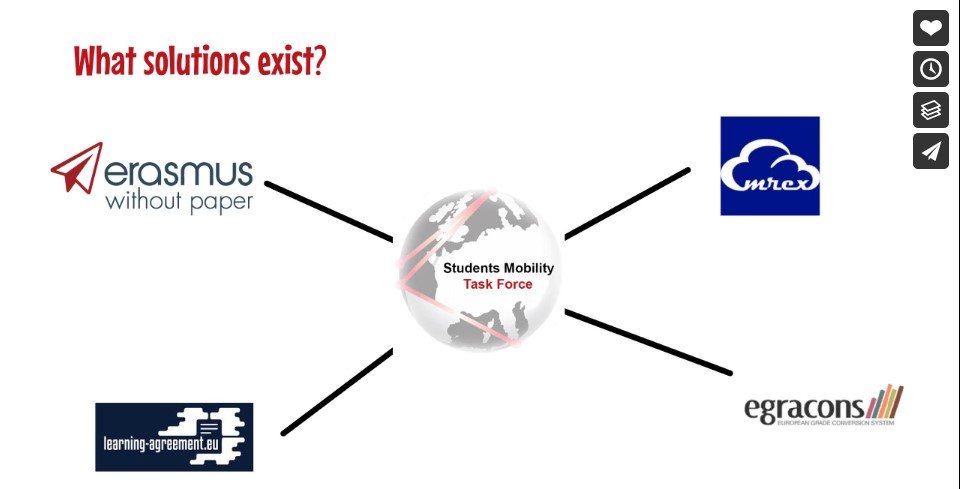
A new EU-CEF project, European Digital Student Service Infrastructure – EDSSI – is just about to be launched. The project’s goal is to establish a “Core service platform”, integrating solutions developed for the Erasmus+ infrastructure by the projects Erasmus Without Papers, the European Student Card and EMREX into the eIDAS framework. The project has 16 partner organizations, some also from the EMREX community. The project contains a range of activities from technical solutions for authentication, security and GDPR, to establishing helpdesk support. Some of the activities will also have impact on EMREX. This will mainly be activities connected to the ELMO format, and the work to set up a common registry which includes EMREX. The project will last for two years.

Expected activities

During the fall the Executive Committee plans to pursue the activities laid out in the year plan. The EUG has also received a grant from the Vietsch foundation of €30.000 to use for dissemination and other activities. Unfortunately we are still heavily affected by the COVID19-virus so it is now impossible to know what dissemination activities are available at the moment. Therefore we have started with one of the deliverables in the Vietsch-grant – industrializing the EMREX Registry and reviewing the ELMO standard. This includes keeping the ELMO format maintained and updated according to new demands. One specific demand here is to deliver better support for recognition and including results of recognition into EMREX. The work package also includes getting better operations conditions for the registry, both make it more reliable and more accessible. Furthermore EMREX is part of different ongoing projects: • EMREX participates in the PIM-project, lead by the Bundesministerium für Bildung und Forschung, for exchanging result data between Germany and existing EMREX countries. • EMREX has a liaison with Europass concerning cooperation on the future format of Europass, to ensure the compatibility with ELMO. • EMREX takes part in ongoing workshops with DAAD, the German Academic Exchange Service. • The European Blockchain Partnership arose in 2018, with the first projects starting up in 2019. EMREX is represented in the Diploma project. • Some of the members of the EMREX community take part in the EDSSI project with special mission to ensure that EMREX interest are taken in consideration.

Get in touch

To contact us write to info@emrex.eu. To get support write to support@emrex.eu.

General Assembly 2020

  – Yearly planAgenda General Assembly 2020EUG General Assembly Minutes

EMREX Newsletter, May 2020


Introduction

At our meeting in Warsaw this year we worked on the year plan and discussed presentations for conferences. 2020 started as a busy year with many interesting events, such as the GDN conference in New Delhi or EUNIS in Helsinki. Five weeks later the world changed completely. Almost everything that seemed so normal to us stopped instantly and was not allowed anymore. These dark times remind us of what is truly important in life, such as family and good health. I hope that you and your loved ones are in good health. To quote and hold on to a Leonard Cohen’s lyrics: “there is a crack in everything, that’s how the light gets in”. This will pass and life will get back to normal, I am sure of that. All the best and keep save, Jan-Joost Norder ChairOne of the regular on-line meetings of the EMREX Executive Committee (from the top left: Poland, Sweden, Norway, Finland, the Netherlands)

EMREX Executive Committee meeting in Warsaw on January 14-15th 2020

The annual physical meeting of the EMREX Executive Committee was held in Warsaw, Poland, 14-15th of January. There were many topics to discuss, among others, changes in the EMREX statutes, realization of the work plan for 2019 (most of the activities have been done or are well under way) and strategy for 2020 (in particular how to professionalize EMREX and to strengthen the EMREX brand), change requirements for ELMO, getting financial aid, which would help us to keep the administrative tasks running. The EMREX portal was refreshed, in particular documents like the EMREX handbook and the Technical guide to EMREX were renewed. As a remainder, the Executive Committee of EMREX consists of the following members:

  • Jan Joost Norder from DUO (Dienst Uitvoering Onderwijs, Netherlands) – chairperson,
  • Geir Vangen from UNIT (Norway) – vice chair,
  • Tor Fridell from LADOK (Sweden) – secretary,
  • Janina Mincer-Daszkiewicz from the University of Warsaw (Poland),
  • Jukka Kohtanen from CSC (Finland).

The election for new Executive Committee will take place in the next Annual Assembly on 15th of June 2020.

Submission for EUNIS 2020 conference in Helsinki

Sharing of student data in the “European Universities” alliances with EMREX The European Commission has launched an initiative called “European Universities” alliances with the goal to enhance the quality and attractiveness of European higher education and boost cooperation between institutions, their students and staff. There are currently 17 funded alliances with 114 participating institutions. The initiative is designed to explicitly strengthen mobility of students and staff. Therefore there is a need for a mechanism for sharing student data. EMREX is here to help! It is an easy-to-implement way to transfer student records between institutions. The transfer itself is very straightforward and the receiving party decides how the data should be made useful, be it just transcript of records or diplomas of double/joint degree programs.

European Universities EU logo and 4EU+ Alliance with the University of Warsaw

EMREX Annual Assembly June 15th  2020

The original plan was to host our Annual Assembly during the EUNIS conference in Helsinki, but due to the COVID-19 outbreak this is not possible anymore. At our meetings we had many discussions about the possibilities for the meeting — postpone it to September/October or carry online. Our first thought was to postpone until autumn, but it is still unsure how the world will look then. Furthermore it was difficult to find a suitable conference were you, our members, would also attend. Postponing to 2021 was not an option for us, because we don’t want to lose contact with our members. After all you elected us and decided what we need to do for the EMREX network. That’s why we decided to hold an online meeting. The Annual Assembly will take place on the 15th of June 2020 at 10.00-12.00 CET, a week after the online EUNIS congress. The most important issue on the agenda is, next to yearly report and forecast for 2021, the (re)election of all the positions on the EMREX Executive Committee. Two years go by very fast. The Executive Committee would also like to increase the group with two members. The following positions are up for election: Position                              Period Chair                                     mid 2020 – mid 2022 Vice-chair                           mid 2020 – mid 2022 Secretary                            mid 2020 – mid 2022 2-4 board members       mid 2020 – mid 2022 The Executive Committee should have a strong presentation of technological, educational and business insight. Any suggestions from/for people who are interested and could give their time for a common and important cause are welcome! If you are interested we would like to receive your brief letter of interest (why would like to join the board) before the 29th of May 2020. You can send your nomination to info@emrex.eu. If you have any questions regarding the election and/or positions you can contact Jan-Joost Norder at janjoost.norder@duo.nl. Additional information can be found here: https://zgfreestyle.hr/emrex/general-assembly/.

EMREX Statutes

The EMREX statutes are under revision and the Executive Committee will propose the revised statutes in the next annual assembly. The proposed statutes will be delivered to the EMREX network beforehand and any comments and questions are welcomed. A need for changing the statutes was recognized as the network has been growing and the service has become established. Through the revised statutes e.g. joining the network will become easier and creating more value to the network is encouraged.

ELMO and EUROPASS

In April 2018, the EU countries adopted the Commission’s proposal to revise the Europass framework. As part of this work, the Europass digital credentials infrastructure (EDCI) is being implemented, to support transparency of skills and qualifications. Some of the functionality of EMREX will overlap with EDCI, and to ensure the connectivity between these two infrastructures, a liaison has been set up to explore this relation. The data model for EDCI has already been aligned with the ELMO/EMREX standard. A task to compare the ELMO and EDCI formats has been initiated, and the result is available on GitHub https://github.com/european-commission-europass/Europass-Learning-Model/tree/release/0.9.0/Correspondence%20Tables/ELMO Concrete examples of diplomas defined by both ELMO and EDCI formats will be produced as part of this liaison.

PIM project in Germany

by Hans-Joachim Feil hans-joachim.feil@capgemini.com The project PIM (Platform for International Student Mobility), headed by the German Federal Ministry of Education and Research, aims to provide a digital service that supports German and foreign students who wish to study abroad or in Germany. PIM will create an overarching framework and ensure that all existing services (e.g. EMREX) can be readily integrated. The main user groups to be supported by PIM are students and university staff. A centrally coordinating and controlling part of PIM is responsible for ensuring the provision of the following functionalities and services, as well as organizing the necessary (core) processes accordingly:

  • Integration of access and self-service functionality for students (e.g. interface to the portal system / OZG functionalities, long-term account).
  • Storage functionality for personal artifacts of students.
  • Standardized structured provision of information, especially study and module information for student applications.
  • (Further) development of services (e.g. module digitization and databases) and standards (e.g. authenticity features of digital educational certificates, information offered by universities).
  • Control and support of user-centered data exchange, including the recognition processes (e.g. digital credentials, recognition histories).

The architectural decisions to have a central platform and decentralized university systems will be based on the once-only principle, as well as university autonomy and students’ data sovereignty. In order to be successful in the long term, the platform needs to be able to connect to solutions on all levels. The data exchange formats (e. g. EMREX) will be interoperable and adaptable, both in the context of the decentralized environment in Germany, as well as the European and international contexts. These requirements were designed in the previous phase of the project until the end of 2019, where a comprehensive concept for the platform was created and first experiences with prototypes were made. For example, the student data exchange between a Norwegian and a German university was tested on the basis of EMREX.  In the recently started “transfer” phase, a minimum viable project (MVP) is being developed to ensure user centricity and optimize the platform before approaching a broader rollout. A number of selected partner universities are involved in the process, which is being led by the Technical University of Berlin and the Georg August University of Göttingen. Concrete use cases have been identified to be implemented in the MVP, which will also be functional for the eventual launch of the platform’s productive operation. One of these use cases is the workflow concerning the recognition of study credits. Another example is a central database of study modules. An important condition is ensuring compatibility with the German Online Access Act (OZG), which requires public services to be digitized by 2022.

German NCP in production

We are happy to announce that in January University of Göttingen as the first German university went into production with EMREX, delivering data to the network through a NCP. University of Göttingen is part of the German PIM-project (Platform for International Student Mobility), and more universities from this project is already included in the EMREX test environment.

Greece  a new EMREX member

As a follow up from the December newsletter; GUnet from Greece has now become member of EMREX. GUnet is in a phase of testing EMREX with a NCP covering all Greece universities.

EMREX and GDPR

Just a heads-up for those building National Contact Points (NCP) or already having one in production. The EMREX protocol itself is inherently GDPR compliant, as the results owner is in charge of the whole process and does active choices in every step when sharing data with third party. However, it is important that every NCP implementer makes sure that enough information of what data will be transferred, especially personal information, is presented to them upfront.

ELMO 1.5

ELMO version 1.5 was launched in January. This includes some extra attributes for the learner, to serve some of the needs of the new German participants. More details can be found here: https://github.com/emrex-eu/elmo-schemas/releases/tag/v1.5.0

  • Added support for additional fields on the learner (placeOfBirh, birthName, currentAddress, gender).
  • Signature on the elmo element is now optional.

Technical documentation for EMREX is upgraded.

Upgrade of the EMREX portal

The portal has had a small upgrade in beginning of May 2020 with a digital option to apply as an associate or full member. As a new member you can easily fill in a form with details about your organization, contact person and logo. This way we hope to lower the threshold and make it easier for parties to join the network. The added benefit is that the network gets an accurate and up-to-date database. Do you have questions about the website? Please send an e-mail to info@emrex.eu.

Apply for an EMREX Membership in the EMREX portal

Get in touch

EMREX portal is available at emrex.eu. To contact us write to info@emrex.eu.  To get support write to support@emrex.eu.

EMREX Newsletter, December 2019


EMREX at EAIE conference in Helsinki

EMREX was present at the 31st edition of the European Association of International Education (EAIE), Encompassing all voices in Helsinki, on 24-27 September 2019. Although the title says “European”, it has become way more than that. Over 6200 professionals from more than 95 countries were present. With almost 240 stands at the exhibition hall, this is one of the largest international Higher Education conferences in the world. EMREX was present at two workshops:  

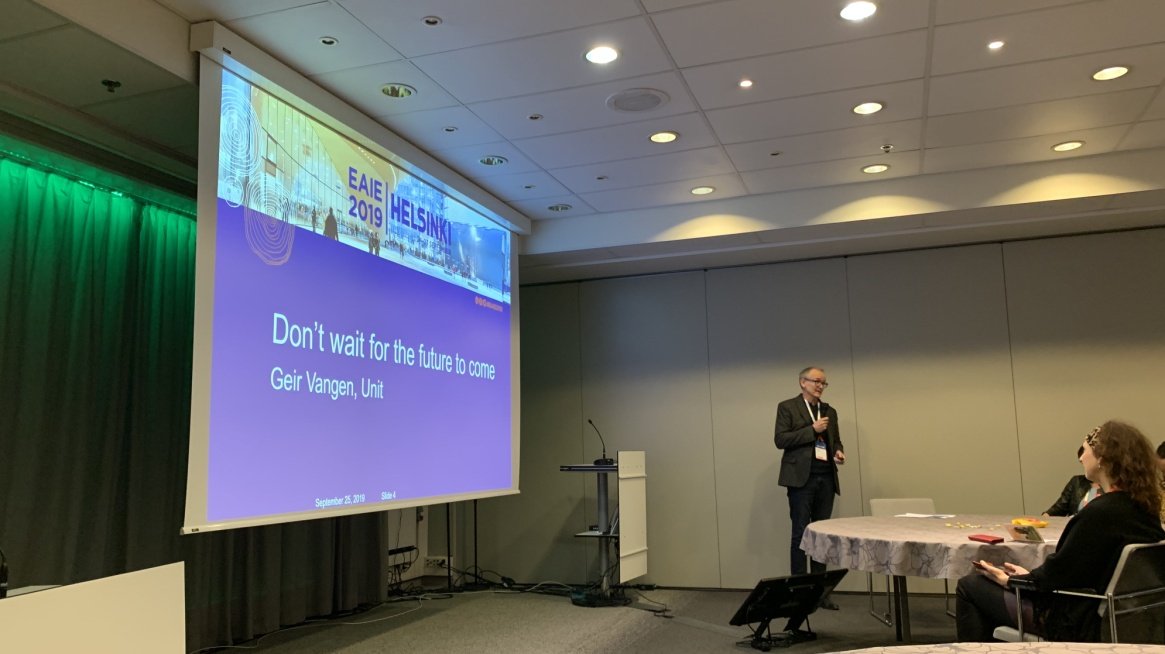
This year for the first time we also had a stand at the exhibition hall, together with Europass and Compleap. A lot of interesting people came by to hear about the great solutions we offer for student mobility. So what did we do? Networking, networking and networking. Hopefully this will result in more organisations and/or countries who will join the network in the near future. China, Greece, Malta, Japan or maybe India? Come and see us next year at the EAIE in Barcelona. Geir Vangen from UNIT presenting EMREX at EAIE 2019 in Helsinki Audience at the EMREX session at EAIE 2019 in Helsinki

Student Data Solutions stand at EAIE 2019 in Helsinki

DEQAR

EMREX was present during on of the slots of the DEQAR conference. The conference was organised in conjunction with the annual EQAR Members’ Dialogue, an event that serves as a forum to discuss current policy developments in quality assurance. The event was held on 7-8th of October 2019 and hosted by the Universidad Carlos III de Madrid (UC3M). The ESG are the Standards and Guidelines for Quality Assurance in the European Higher Education Area (EHEA). As part of the Bologna Process, European ministers responsible for higher education adopted the ESG as a common framework for quality assurance.  EQAR (European Quality Assurance Register for Higher Education) is the official register of quality assurance agencies operating in substantial compliance with the ESG. DEQAR is the Database of External Quality Assurance Results produced by EQAR-registered quality assurance agencies.

Tor Fridell, who represented EMREX, could not be present in person so the attendance was made possible via cyberspace.

Germany goes EMREX (by Guido Bacharach, Head of Strategy and Digitization Unit Stiftung für Hochschulzulassung)

“Hopeless” – this was an expression that fell in connection with the EMREX activities in Germany – in the past certainly rightly so. In the last EMREX Newsletter Hans-Joachim Feil of Capgemini mentioned the German project Platform for International Student Mobility (PIM) and its relation to EMREX. In the meantime, there are other German initiatives which have a direct relation to ELMO and EMREX, among others:  

  • The German Community for Certificate Validation: German universities, ministries, authorities and public service providers have joined forces to develop a common standard for German certificate digitization and validation. EMREX/ELMO will be indispensable here for international exchange.
  • From this community, Bundesdruckerei and the Harz University of Applied Sciences, among others, are developing prototypes for National Contact Points (NCPs) in cooperation with the Stiftung für Hochschulzulassung (SfH). Bundesdruckerei’s prototype is to be completed by the end of the year, and the Harz University prototype has just passed its first successful tests.
  • The first extensions of the ELMO standard for German use have been included as a requirement.
  • Within the framework of the German Online-Zugangs-Gesetz (Online-Access-Law – OZG), the electronic validation of certificates (upper secondary school and university) in Germany is planned for start within 2020. This solution is to include the above-mentioned PIM project and the support of EMREX.

The EMREX situation in Germany can be described as quite “hopeful”.

Bunderministerium project meeting in Berlin, summer 2019.

EMREX Network new member

We welcome Freie Universität Berlin as an associate member of the EMREX User Group. They are currently writing up an application for third-party founding of a digital mobility project, in the context of which they would want to implement EMREX.

GUnet from Greece interested in EMREX (by Nikos Voutsinas from GUnet)

GUnet is a non-profit organization founded in 2000 by all Greek universities with the mandate to drive the digital innovation in Greek higher education institutions (HEIs). GUnet’s mission includes the coordination of initiatives that advance the eGovernance in education and research, the design and development of application platforms for HEIs, and the delivery of digital services for education that run at national level. In its role as central service provider, GUnet has developed strong expertise in the areas of data governance, identity management and e-learning, and through its national service hub provides the data linkages and connection services between the Greek HEIs and the rest of the world. While the EMREX project was in GUnet’s radar, we never had the opportunity to meet in person the people behind the EMREX project, until the EUNIS 2019 Annual Congress in Trondheim, Norway. With the students mobility challenge being at the top of the agenda, it was very easy to agree upon the common goals. The EMREX network provides the ideal platform to coordinate institutions and national data providers in pioneering the establishment of a European framework for the exchange of student transcripts. It also became obvious that the platform would be an important contribution in the endeavor to achieve a European inter-university campus that goes beyond the existing cooperation models. The EMREX workshop in November, held at the GUnet premises in Athens, increased the awareness of the EMREX network within the Greek HEIs. This two-day workshop was the perfect opportunity to bring together the EMREX representatives with development teams and decision makers from the Greek HEIs, and identify opportunities for cooperation and synergies. The workshop helped us to understand the steps of engagement and the anticipated benefits in the provisioning of international students in the student information systems (SIS), and the development of cross-border services. Following the EMREX workshop, the GUnet administrative board decided to join the EMREX network and set up a work plan for the required immediate, mid and long term actions. In particular, GUnet has decided to proceed in the next two months with the implementation of the Greek NCP and the integration of the Greek eDiplomas platform into the EMREX network via an ELMO gateway. Subsequently, the national initiative for upgrading the SIS in Greek HEIs will pave the way towards the compliance of the Greek SIS specifications with the EMREX APIs for courses, grades and credits.  The platform envisaged by GUnet will combine existing technologies in order to provide maximal protection while keeping the student records usable in a flexible but controlled manner, and enhance interoperability and collaboration between HEIs at national and European level.

The EMREX workshop held at the GUnet premises in Athens, November 2019

EMREX Executive Committee will meet in Warsaw on January 14-15th 2020

The annual meeting of the EMREX Executive Committee will be held in Warsaw, Poland, in the middle of January. There are many topics to discuss, among others changes in the EMREX statutes, realization of the work plan for 2019 and strategy for 2020, change requirements for ELMO, getting financial aid, which would help us to keep the administrative tasks running. As the remainder, the Executive Committee of EMREX consists of the following members:

  • Jan Joost Norder from DUO (Dienst Uitvoering Onderwijs, Netherlands) – chairperson
  • Geir Vangen from UNIT (Norway) – vice chair
  • Tor Fridell from LADOK (Sweden) – secretary
  • Janina Mincer-Daszkiewicz from the University of Warsaw (Poland)
  • Jukka Kohtanen from CSC (Finland).

Want to join? Need support?

Many technical teams look for information and support, which would help them to smoothly implement EMREX NCP and/or SMP. There is a special Support section in the ERMREX portal (https://zgfreestyle.hr/emrex/support/), with the EMREX handbook (mostly oriented towards authorities and technical leaders), EMREX Technical Description (for IT personnel and helpdesks), EMREX technical guide and contact data where you can ask for assistance. Last but not least, the EMREX community maintains a stable test environment, which can be used during development and for acceptance testing. Contact us if you want to get access to the EMREX test network.

EMREX test network (Polish test SMP)

Be in touch

EMREX portal is available at emrex.eu. To contact us write to info@emrex.eu. To get support write to support@emrex.eu.
Freie Universität Berlin joins EMREX


We welcome Freie Universität Berlin as associate member of the EMREX User Group.

They are currently writing up an application for third-party founding of a digital mobility project, in the context of which they would want to implement EMREX.

Contact Person:

 Achim Stenzel 

DEQAR conference

EMREX was present during one of the slots of the DEQAR conference. The DEQAR Conference was organised in conjunction with the annual EQAR Members’ Dialogue, an event that serves as a forum to discuss current policy developments in quality assurance during monad october 7 to tuesday october 8. The event was hosted by the Universidad Carlos III de Madrid (UC3M). The ESG are the Standards and Guidelines for Quality Assurance in the European Higher Education Area (EHEA). As part of the Bologna Process, European ministers responsible for higher education adopted the ESG as a common framework for quality assurance. EQAR (European Quality Assurance Register for Higher Education) is the official register of quality assurance agencies operating in substantial compliance with the ESG. DEQAR is the Database of External Quality Assurance Results produced by EQAR-registered quality assurance agencies.Tor Fridell, who represented EMREX could not be present in person so the attendance was made possible via cyberspace.

EMREX Newsletter, September 2019


Digitalization & Recognition. The 2019 DigiRec mini conference in Tallinn, Estonia (by Jenneke Lokhoff from Nuffic)

On 8-9 May stakeholders in the recognition gathered in Tallinn upon invitation of the Archimedes Foundation, to ensure their views are included in the final version of the DigiRec White Paper. The paper is developed by and for the ENIC-NARIC networks (the national academic information centres for recognition) as part of the EU Key Action 3 Erasmus+ DigiRec project. Its purpose is to assist ENIC-NARICs to better prepare for digitization and integrate digitization in their process, by making first systematic analysis between digital student data and the recognition of foreign qualifications. The day before the conference, the 38 participants visited e-Estonia. The actual mini conference kicked off with a three mini keynotes from EMREX, the European Commission and a credential evaluator. Next the paper was introduced and followed by two rounds of 3 identical breakout sessions on the main chapters of the White Paper, focused on input, throughput and output. The conference closed with a panel consisting of the President of the LRC Committee.

Geir Vangen from UNIT, Norway explains difference between document image and structured data

The outcomes included a wealth of comments on the paper. These included the importance of the following more general observations made:

  • It is essential that data and policy experts connect to create practical and sustainable solutions;
  • From a data maturity perspective, credential evaluation is only at the very first stage of digitization, but its further progression will depend on many other actors in the student data ecosystem;
  • Digitization of student data and of credential evaluation is a moving target. It is essential that the key stakeholders in the EHEA keep in dialogue with each other to tune initiatives where possible to fully reap the benefits for recognition. The BFUG, the 4 E’s, but also the ENIC-NARIC networks should make digitization topic a priority;
  • If ENIC-NARIC centres are working on the acceptance of standardized data for the input phase, it would also be important for them to come up with standards for the output phase, as they will be responsible for the issuance and ultimately the legibility of that data.
  • Opening a dialogue and setting up training opportunities with IT experts from ENIC-NARIC centres could sharpen the technical recommendations formulated in the White Papers and would help staff feel more confident about upcoming transitions.

The DigiRec White Paper is expected to be published Autumn 2019. The DigiRec consortium consists of EMREX, Groningen Declaration Network, ENIC-NARICs from Poland, Sweden, Italy, France and Canada, the President of the ENIC Bureau and the President of the LRC Committee.

EMREX User Group Annual Assembly in Trondheim

The Annual EMREX User Group Assembly was held in Trondheim, Norway on the first week of June 2019, just before the European Universities Information Systems (EUNIS) 2019 conference. Full member country representatives from Finland, The Netherlands, Norway, Sweden and Poland were present at the meeting alongside other participants from EMREX User Group Countries. Croatia, who launched their NCP in August 2018, was formally accepted as a full member of the EMREX User Group. Croatia is represented by the Agency for Science and Higher Education (ASHE), Igor Drvodelić from ASHE will be acting as the voting member for Croatia. At the end of the meeting Mirko Stanic from the Agency for Science and Higher Education of Croatia presented blockchain technology from the perspective of EMREX perspective and outlined how technical solutions like blockchain could be used to extend EMREX. The Executive Committee (EC) presented the yearly report of 2018 and the year plan for 2019. These documents can be found in the EMREX portal. As a main focus areas for 2019, the EC has set to strengthen and extend the EMREX community and build up EMREX as an established long-term service; continue and improve the close collaboration with other European projects and continue standardisation work (i.e. ELMO). Following the discussion at the Annual Assembly, investigating new funding opportunities this year will be added to the yearly plan. More emphasis will also be put to on marketing and communications that support the goal to engage new partners in the community. In addition, the renewal of the emrex.eu website will continue during the fall. The full minutes of the meeting can be found in the EMREX wiki. The Annual Assembly for 2020 will be planned in conjunction with EUNIS 2020 in Helsinki, Finland.

Presentation by Mirko Stanic on blockchain at the EMREX Assembly meeting in Trondheim

EMREX at EUNIS 2019 conference in Trondheim, Norway

EMREX was present at the EUNIS conference at various venues. First, during the pre-conference workshop on Student Mobility (June 4th, 2019) Jan-Joost Norder, the chair of the EMREX Executive Committee, explained in his presentation What is EMREX and what issues does it solve. Jan-Joost presented the aims and requirements of the EMREX Network, current state of EMREX (architecture and functionality), EMREX connections and dependencies, and the future of the Network, in particular upcoming developments.

Jan-Joost Norder presenting EMREX at the workshop on student mobility
Session break, time to exchange ideas

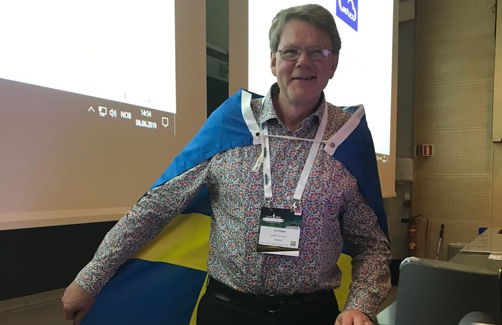
EMREX was also present during the EUNIS 2019 conference on June 5-7, 2019. Tor Fridell from the LADOK consortium in Sweden, as the representative of the EMREX Executive Committee, delivered the presentation Supporting Student Mobility — news from the EMREX network. Tor, wrapped in the Sweden national flag (the presentation was held on the Swedish national day) presented news from the EMREX network — on development, expansion, and plans for the future. The EMREX solution was demonstrated live during the session. Geir Vangen and Marte Holhjem from UNIT, the Norwegian Directorate for ICT and Joint Services in Higher Education and Research, presented the Diploma portal, used by students to share their results. This solution is also based on the EMREX Network and ELMO data standard.

Tor Fridell wrapped in the Swedish national flag talking about EMREX at the EUNIS conference

EMREX goes beyond the Arctic Circle!

2019 NUAS Forum, entitled The digital Workplace – Skills For a Changing World, took place in Tromsø, August 14-16, 2019. NUAS Forum gives people and groups the opportunity to work together to develop greater interdepartmental, intra-institutional, and international understanding of the challenges and opportunities on the horizon for our sector; particularly with regards to Digitalization in Nordic universities. Geir Vangen from UNIT, Norway, presented the EMREX Network in his talk Digital Transfer of Student Records – News From the EMREX Network. How can this system assist institutions with international admission and recognition?

EMREX at EAIE conference in Helsinki, Finland

EMREX will join the 31st Annual EAIE Conference and Exhibition, to be held in Helsinki, Finland on 24- 27 September 2019. This includes a joint session run by UNIT and NOKUT from Norway and Digitary from Ireland. The session has the title How we build internet of trust to streamline academic recognition and enhance employability of graduates and the abstract is available at: https://www.eaie.org/helsinki/programme/programme-overview/activity/1831.html The other session, entitled Admission and Recognition presents: Credential evaluation in a digitising society: exploring benefits and challenges, will be run jointly by CIMEA from Italy, UNIT from Norway, UHR from Sweden, and Groningen Declaration Network from the Netherlands. The abstract is available at: https://www.eaie.org/helsinki/programme/programme-overview/activity/1742.html Meet EMREX at stand J57 in Helsinki!

EMREX at NOKUT (by Nina Strand from NOKUT)

NOKUT are looking for solutions where they can automate the verification process of documents received from their applicants. In this context NOKUT have implemented a connection to EMREX into NOKUT’s applicant portal. That means that users from countries connected to EMREX can attach their diplomas and transcripts to their application. The first implementation is a pilot where only documents are added to the application. The reason for the pilot is that there is not much test data available today, and the documentation is a bit outdated. The plan is to retrieve diplomas as structured data, so the verification can be done automatically. NOKUT has a collaboration with UNIT to improve EMREX so that this goal can be reached. There have been some challenges during the implementation of EMREX. There is not much test data, and not all contact points have test environments available. The development team has spent time trying to figure out how things should be implemented correctly, to ensure that the integration supports all the countries in the EMREX network. To NOKUT, data transfer through EMREX ensures the validity of the data and reduces the need for manual verification through correspondence with the issuing institution or database searches. In the long run, EMREX would also allow to automate parts of the recognition process. However, further work with EMREX requires more available test data and better documentation to ensure right system behaviour. The EMREX partners must also ensure not using self signed certificates in their production environment and maintain their test environments, if NOKUT is to get any value from this functionality.

NOKUT application portal

NOKUTs implementation: When users apply for “Recognition of foreign higher education” they select the country of study. If this country is associated with EMREX, they will get a message asking if they want to retrieve their diplomas from EMREX. If they wish to collect their results from EMREX, the applicants are sent to an external site where they can choose which information they want to add to their application. This information is then forwarded to the application, and the applicant is sent back to the application portal.

Germany EMREX pilot (by Hans-Joachim Feil from Capgemini)

Within the aim of the Bologna Process, German universities goal is to increase international and European study programs and study exchanges. Although German Students are among the most mobile of all large industrial countries, there is still room for improvement. A main reason for this is the lack of digitally supported back office processes within German universities, which leads to slow and inefficient processing times. To solve this problem, the Federal Ministry of Education and Research has initiated the project platform of international student mobility (PIM), which will benefit not only student applicants but also university examination boards and administration offices. The vision of the PIM project is to develop a conceptual and technical framework for a platform that will focus on digitalizing and standardizing back and front office processes within the structures of academic recognition. The platform will enable participating German universities to interoperably digitalize processes of international student mobility and as a result also German students’ outbound mobility. In simplest terms, PIM is meant to enable easy access to, storage, and management of data. The three main processes the platform will focus on improving to achieve this goal is the submission of academic transcripts, the support of the validation and digital processing of academic transcripts, and the provision and maintenance of information relevant to the recognition of academic transcripts. The project will focus and orientate itself on international best practices and benchmarks, while adhering to the international organizational and technical standards of ELMO and EMREX. The project has four set phases; elevation and analysis, target conception and validation, transformation and specifications book, of which the project is currently in the third phase. During the following transformation stage the development of operator models, derivation of governance structure and resource planning will be carried out. Currently, the specifications book is being drafted and the central functionalities of the platform are being piloted with several universities, the most notable being the EMREX pilot with the RWTH Aachen University and Trondheim University.

Be in touch

EMREX portal is available at emrex.eu. To contact us write to info@emrex.eu. To get support write to support@emrex.eu. Or use the contact forms below.

For information

For support

Annual Assembly 2019


THE EMREX 2019 ANNUAL ASSEMBLY

The EMREX Annual Assembly for 2019 will be held on June 3rd (Monday), 16.00-19:00 in Trondheim, Norway. It is co-located and co-timed with the EUNIS 2019 conference (starting on Wednesday) and the EUNIS pre-workshop on student mobility (Tuesday) so that it is possible to attend all events.

Documents for the assembly