EMREX Newsletter, September 2019


Digitalization & Recognition. The 2019 DigiRec mini conference in Tallinn, Estonia (by Jenneke Lokhoff from Nuffic)

On 8-9 May stakeholders in the recognition gathered in Tallinn upon invitation of the Archimedes Foundation, to ensure their views are included in the final version of the DigiRec White Paper. The paper is developed by and for the ENIC-NARIC networks (the national academic information centres for recognition) as part of the EU Key Action 3 Erasmus+ DigiRec project. Its purpose is to assist ENIC-NARICs to better prepare for digitization and integrate digitization in their process, by making first systematic analysis between digital student data and the recognition of foreign qualifications. The day before the conference, the 38 participants visited e-Estonia. The actual mini conference kicked off with a three mini keynotes from EMREX, the European Commission and a credential evaluator. Next the paper was introduced and followed by two rounds of 3 identical breakout sessions on the main chapters of the White Paper, focused on input, throughput and output. The conference closed with a panel consisting of the President of the LRC Committee.

Geir Vangen from UNIT, Norway explains difference between document image and structured data

The outcomes included a wealth of comments on the paper. These included the importance of the following more general observations made:

  • It is essential that data and policy experts connect to create practical and sustainable solutions;
  • From a data maturity perspective, credential evaluation is only at the very first stage of digitization, but its further progression will depend on many other actors in the student data ecosystem;
  • Digitization of student data and of credential evaluation is a moving target. It is essential that the key stakeholders in the EHEA keep in dialogue with each other to tune initiatives where possible to fully reap the benefits for recognition. The BFUG, the 4 E’s, but also the ENIC-NARIC networks should make digitization topic a priority;
  • If ENIC-NARIC centres are working on the acceptance of standardized data for the input phase, it would also be important for them to come up with standards for the output phase, as they will be responsible for the issuance and ultimately the legibility of that data.
  • Opening a dialogue and setting up training opportunities with IT experts from ENIC-NARIC centres could sharpen the technical recommendations formulated in the White Papers and would help staff feel more confident about upcoming transitions.

The DigiRec White Paper is expected to be published Autumn 2019. The DigiRec consortium consists of EMREX, Groningen Declaration Network, ENIC-NARICs from Poland, Sweden, Italy, France and Canada, the President of the ENIC Bureau and the President of the LRC Committee.

EMREX User Group Annual Assembly in Trondheim

The Annual EMREX User Group Assembly was held in Trondheim, Norway on the first week of June 2019, just before the European Universities Information Systems (EUNIS) 2019 conference. Full member country representatives from Finland, The Netherlands, Norway, Sweden and Poland were present at the meeting alongside other participants from EMREX User Group Countries. Croatia, who launched their NCP in August 2018, was formally accepted as a full member of the EMREX User Group. Croatia is represented by the Agency for Science and Higher Education (ASHE), Igor Drvodelić from ASHE will be acting as the voting member for Croatia. At the end of the meeting Mirko Stanic from the Agency for Science and Higher Education of Croatia presented blockchain technology from the perspective of EMREX perspective and outlined how technical solutions like blockchain could be used to extend EMREX. The Executive Committee (EC) presented the yearly report of 2018 and the year plan for 2019. These documents can be found in the EMREX portal. As a main focus areas for 2019, the EC has set to strengthen and extend the EMREX community and build up EMREX as an established long-term service; continue and improve the close collaboration with other European projects and continue standardisation work (i.e. ELMO). Following the discussion at the Annual Assembly, investigating new funding opportunities this year will be added to the yearly plan. More emphasis will also be put to on marketing and communications that support the goal to engage new partners in the community. In addition, the renewal of the emrex.eu website will continue during the fall. The full minutes of the meeting can be found in the EMREX wiki. The Annual Assembly for 2020 will be planned in conjunction with EUNIS 2020 in Helsinki, Finland.

Presentation by Mirko Stanic on blockchain at the EMREX Assembly meeting in Trondheim

EMREX at EUNIS 2019 conference in Trondheim, Norway

EMREX was present at the EUNIS conference at various venues. First, during the pre-conference workshop on Student Mobility (June 4th, 2019) Jan-Joost Norder, the chair of the EMREX Executive Committee, explained in his presentation What is EMREX and what issues does it solve. Jan-Joost presented the aims and requirements of the EMREX Network, current state of EMREX (architecture and functionality), EMREX connections and dependencies, and the future of the Network, in particular upcoming developments.

Jan-Joost Norder presenting EMREX at the workshop on student mobility
Session break, time to exchange ideas

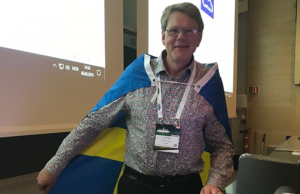
EMREX was also present during the EUNIS 2019 conference on June 5-7, 2019. Tor Fridell from the LADOK consortium in Sweden, as the representative of the EMREX Executive Committee, delivered the presentation Supporting Student Mobility — news from the EMREX network. Tor, wrapped in the Sweden national flag (the presentation was held on the Swedish national day) presented news from the EMREX network — on development, expansion, and plans for the future. The EMREX solution was demonstrated live during the session. Geir Vangen and Marte Holhjem from UNIT, the Norwegian Directorate for ICT and Joint Services in Higher Education and Research, presented the Diploma portal, used by students to share their results. This solution is also based on the EMREX Network and ELMO data standard.

Tor Fridell wrapped in the Swedish national flag talking about EMREX at the EUNIS conference

EMREX goes beyond the Arctic Circle!

2019 NUAS Forum, entitled The digital Workplace – Skills For a Changing World, took place in Tromsø, August 14-16, 2019. NUAS Forum gives people and groups the opportunity to work together to develop greater interdepartmental, intra-institutional, and international understanding of the challenges and opportunities on the horizon for our sector; particularly with regards to Digitalization in Nordic universities. Geir Vangen from UNIT, Norway, presented the EMREX Network in his talk Digital Transfer of Student Records – News From the EMREX Network. How can this system assist institutions with international admission and recognition?

EMREX at EAIE conference in Helsinki, Finland

EMREX will join the 31st Annual EAIE Conference and Exhibition, to be held in Helsinki, Finland on 24- 27 September 2019. This includes a joint session run by UNIT and NOKUT from Norway and Digitary from Ireland. The session has the title How we build internet of trust to streamline academic recognition and enhance employability of graduates and the abstract is available at: https://www.eaie.org/helsinki/programme/programme-overview/activity/1831.html The other session, entitled Admission and Recognition presents: Credential evaluation in a digitising society: exploring benefits and challenges, will be run jointly by CIMEA from Italy, UNIT from Norway, UHR from Sweden, and Groningen Declaration Network from the Netherlands. The abstract is available at: https://www.eaie.org/helsinki/programme/programme-overview/activity/1742.html Meet EMREX at stand J57 in Helsinki!

EMREX at NOKUT (by Nina Strand from NOKUT)

NOKUT are looking for solutions where they can automate the verification process of documents received from their applicants. In this context NOKUT have implemented a connection to EMREX into NOKUT’s applicant portal. That means that users from countries connected to EMREX can attach their diplomas and transcripts to their application. The first implementation is a pilot where only documents are added to the application. The reason for the pilot is that there is not much test data available today, and the documentation is a bit outdated. The plan is to retrieve diplomas as structured data, so the verification can be done automatically. NOKUT has a collaboration with UNIT to improve EMREX so that this goal can be reached. There have been some challenges during the implementation of EMREX. There is not much test data, and not all contact points have test environments available. The development team has spent time trying to figure out how things should be implemented correctly, to ensure that the integration supports all the countries in the EMREX network. To NOKUT, data transfer through EMREX ensures the validity of the data and reduces the need for manual verification through correspondence with the issuing institution or database searches. In the long run, EMREX would also allow to automate parts of the recognition process. However, further work with EMREX requires more available test data and better documentation to ensure right system behaviour. The EMREX partners must also ensure not using self signed certificates in their production environment and maintain their test environments, if NOKUT is to get any value from this functionality.

NOKUT application portal

NOKUTs implementation: When users apply for “Recognition of foreign higher education” they select the country of study. If this country is associated with EMREX, they will get a message asking if they want to retrieve their diplomas from EMREX. If they wish to collect their results from EMREX, the applicants are sent to an external site where they can choose which information they want to add to their application. This information is then forwarded to the application, and the applicant is sent back to the application portal.

Germany EMREX pilot (by Hans-Joachim Feil from Capgemini)

Within the aim of the Bologna Process, German universities goal is to increase international and European study programs and study exchanges. Although German Students are among the most mobile of all large industrial countries, there is still room for improvement. A main reason for this is the lack of digitally supported back office processes within German universities, which leads to slow and inefficient processing times. To solve this problem, the Federal Ministry of Education and Research has initiated the project platform of international student mobility (PIM), which will benefit not only student applicants but also university examination boards and administration offices. The vision of the PIM project is to develop a conceptual and technical framework for a platform that will focus on digitalizing and standardizing back and front office processes within the structures of academic recognition. The platform will enable participating German universities to interoperably digitalize processes of international student mobility and as a result also German students’ outbound mobility. In simplest terms, PIM is meant to enable easy access to, storage, and management of data. The three main processes the platform will focus on improving to achieve this goal is the submission of academic transcripts, the support of the validation and digital processing of academic transcripts, and the provision and maintenance of information relevant to the recognition of academic transcripts. The project will focus and orientate itself on international best practices and benchmarks, while adhering to the international organizational and technical standards of ELMO and EMREX. The project has four set phases; elevation and analysis, target conception and validation, transformation and specifications book, of which the project is currently in the third phase. During the following transformation stage the development of operator models, derivation of governance structure and resource planning will be carried out. Currently, the specifications book is being drafted and the central functionalities of the platform are being piloted with several universities, the most notable being the EMREX pilot with the RWTH Aachen University and Trondheim University.

Be in touch

EMREX portal is available at emrex.eu. To contact us write to info@emrex.eu. To get support write to support@emrex.eu. Or use the contact forms below.

For information

For support

EMREX Newsletter, March 2019


SAVE THE DATE FOR THE EMREX 2019 ANNUAL ASSEMBLY

The EMREX Annual Assembly for 2019 will be held on June 3rd (Monday), 15.00-18:00 in Trondheim, Norway. It is co-located and co-timed with the EUNIS 2019 conference (starting on Wednesday) and the EUNIS pre-workshop on student mobility (Tuesday) so that it is possible to attend all events. Agenda will be published in May. Suggestions from members of topics to deal with should be sent to the secretary (info@emrex.eu) by May 3rd.

SAVE THE DATE FOR THE EMREX 2019 ANNUAL ASSEMBLY

The EMREX Annual Assembly for 2019 will be held on June 3rd (Monday), 15.00-18:00 in Trondheim, Norway. It is co-located and co-timed with the EUNIS 2019 conference (starting on Wednesday) and the EUNIS pre-workshop on student mobility (Tuesday) so that it is possible to attend all events. Agenda will be published in May. Suggestions from members of topics to deal with should be sent to the secretary (info@emrex.eu) by May 3rd.

ELMO 1.4 SUPPORTING DIPLOMA SUPPLEMENT HAS BEEN RELEASED

  Version 1.4 of ELMO has now been released on GitHub: https://github.com/emrex-eu/elmo-schemas/releases/tag/v1.4.0 The new version includes structure for Diploma Supplement data and is based on the results of the workshop in Helsinki in September 2018. This update enables producers of ELMO Diploma data to add Diploma Supplement information as structural data, in addition to the DS-document itself. Thereafter the EMREX and EWP networks will be able to exchange Diploma Supplement structured data.

CROATIA IS NOW A FULL MEMBER OF THE EMREX USER GROUP (EUG)

Croatia has been accepted as a full member to the EMREX User Group (EUG). As it is stated in the EMREX User Group Statutes a full-member needs to be responsible for one or more NCPs. Full-members are the foundation of EUG and all have one vote per country. The Croatian NCP (National Contact Point) was launched last fall and it can be used by all higher education institutions in Croatia. Croatia is represented by the Agency for Science and Higher Education (ASHE). Igor Drvodelić from ASHE will be acting as the voting member for Croatia. Croatia’s membership will be confirmed in the forthcoming EMREX Annual Assembly later this year. The other full-member countries of EUG are Finland, Denmark, Italy, The Netherlands, Norway, Poland and Sweden. For more information on how to join the EMREX Network see https://zgfreestyle.hr/emrex/how-to-join.

EMREX PRESENTED AT CONFERENCES IN 2018

In 2018 EMREX has been represented in the Taking forward the EU Student eCard initiative run by the European Commision (DG Connect and DG EAC). The network has also been presented at various conferences and events. Some of them are listed below:

In addition EMREX has been presented at a number of national conferences, and there has been held several technical workshops with companies, public bodies, universities for the implementation of EMREX. EMREX will also join the next EAIE conference. This includes a joint session run by UNIT and Nokut from Norway and Digitary from Ireland. The session has the title ”How we build internet of trust to streamline academic recognition and enhance employability of graduates”.

EMREX EXECUTIVE COMMITTEE MET IN WARSAW ON JANUARY 8-9TH, 2019

EMREX Executive Committee met on January 8-9th, 2019 to discuss the realization of the work plan for 2018, as well as goals and strategy for 2019. The goals for 2018 have been obtained according to work plan, the only activity which has been postponed until 2019 is preparation of information materials to be used at various events and posted in the EMREX portal. The work plan for 2019 contains:

  • Implementing of ELMO 1.4.
  • Results recognition, workshop on requirements
  • Supporting grade conversion by means of Egracons
  • Market the possibility to open the student registry for employers
  • Update the emrex.eu website.
  • Strengthen the collaboration with ongoing EU-projects.
  • Seek other collaboration opportunities.
  • Create general information material.
  • Send regular newsletters to the members.
  • Seek to increase memberships
  • Hold the Annual Assembly meeting.

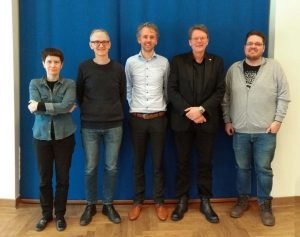
Jan Joost Norder from DUO (Dienst Uitvoering Onderwijs, Netherlands) will continue his duty as the chair.Geir Vangen from UNIT (Norway) as vice chair, and Tor Fridell from LADOK (Sweden) as the secretary. The remaining members of the Executive Committee are Janina Mincer-Daszkiewicz from the University of Warsaw (Poland) and Jukka Kohtanen from CSC (Finland).