EMREX Newsletter, September 2021


News from the EMREX Annual Assembly 2021

On June 14, 2021 the EMREX Annual Assembly was held. This year like the previous one it was held online. The yearly report from 2020 was presented and accepted, just as the yearly plan for 2021. Apart from the usual agenda items stated in the statutes there was one Keynote, Digitally authenticated and machine-readable certificates in Germany by Jörg Rückriemen, Bundesdruckerei and also a Case study Use of ELMO to transport recognitions from PIM to the Campus Management Systems by Bettina Bube, University of Göttingen.

One agenda item was the decision to move the EMREX Registry (EMREG) into the EWP Registry. It was decided to proceed with this and get in touch with EWP/EDSSI to clarify the details. The goal would be to have this completed by the end of the year. See separate chapter in this newsletter.

The Executive Committee’s report was presented with the Yearly report and the plan for 2021. One question was raised about Single Digital Gateway and specifically the second phase and the Once Only Principle it has wide effects in the EU area. It was decided that a position paper on the matter will be prepared and sent to appropriate parties to share our views from EMREX perspective. See separate chapter in this newsletter.

At the meeting the following new members were welcomed into the EMREX User Group:

  • German Academic Exchange Service, Germany,
  • RECSIE, Research Consortium for the Sustainable Promotion of International Education, Japan,
  • Otentica, the Netherlands,
  • Diplomatic Research and Policy Foundation, North Macedonia,
  • Sphairas, Germany.

All documents can be found at https://zgfreestyle.hr/emrex/documents/.

EMREX at EUNIS 2021

EMREX was represented at the 2021 EUNIS conference. It was this year also held online but partly on a virtual Greek island with the possibility to interact with both sponsors and other participants.

EMREX was part of the pre-congress workshop on June 1st.

The workshop was entitled Everywhere and Nowhere: student mobility in the era of micro learning, digital credentials and blockchain and covered a broad range of topics relating to student mobility. An interesting point is that digital transformation (such as micro credentials) are driven now also by the groups interested in teaching and learning. More information can be found here: https://www.eunis.org/eunis2021/sessions/everywhere-and-nowhere/.

EMREX also had a presentation in the slot Interoperability across the EU. Topics and presentations can be found here: https://www.eunis.org/eunis2021/sessions/interoperability-across-the-eu/.

More EMREX at EUNIS 2021 – EUNIS Elite Award

For a long time Germany was seen as a hopeless case concerning EMREX and digitization. Based on support especially from the Netherlands and also from Norway, Germany was able to achieve significant successes in the last two years. Projects such as StudIES+, PIM and the digital certificate prototype of the Bundesdruckerei have already been reported in the EMREX newsletters.

This was the basis on which the German organizations Stiftung für Hochschulzulassung (SfH), Technische Universität München (TUM), Georg-August Universität Göttingen, Hochschule Harz, CyberSec-LSA, Hochschul-Informations-System eG (HIS) and last but not least the Dutch Dienst Uitvoering Onderwijs (DUO), the mentor of many German digitization initiatives, wrote a joint paper for this year’s EUNIS annual conference entitled Progress on Digitization of Higher Education Processes towards Standards EU & DE. This paper provides a rather comprehensive overview of the current successes as well as problems and future challenges of German digitization in higher education. EMREX is mentioned 14 times in this paper, a sign how important EMREX was, is and will be in the digital transformation of the German education sector as well.

Thus, it is also a merit of EMREX that this paper won the EUNIS Elite Award for excellence in implementing Information Systems for Higher Education.

The winning paper can be found at Progress on Digitization of Higher Education Processes towards Standards EU & DE: Status and future Perspectives.

Authors of the winning paper

Digital Credentials: International Frameworks, Interoperable Standards, and Trust

(contribution by Dr. Matthias Gottlieb, Technical University of Munich, Germany)

On June 16th, 2021, the project Digital Credentials for Higher Education Institutions (in German Digitale Bildungsnachweise für Hochschulen, DiBiHo, https://www.dibiho.de) hosted virtually the 1st International Stakeholder Dialogue. The event offered for the project, which is funded by the German Federal Ministry of Education and Research (BMBF), is an excellent opportunity to connect with Higher Education Institution (HEI) professionals working in Administration & IT, International Offices, and in Management & Strategy, with regulators and policy-makers on national and EU level, with developers, operators, and researchers from the Digital Credentials Community around the world.

Dr. Matthias Gottlieb from the Technical University of Munich (TUM) introduced the research project as a joint project (TUM, Hasso-Plattner-Institut (HPI), and the German Academic Exchange Service (DAAD)). Afterward, Kim Hamilton Duffy (Chair of the W3C Credentials Community Group at MIT) and Philipp Schmidt (Director of Digital Learning and Collaboration, MIT Media Lab) advocated in their

presentation a case for standards in achieving interoperability. The keynote highlighted the importance of international collaboration within the Verifiable Credentials ecosystem and established common ground with the DCC’s (https://digitalcredentials.mit.edu/) guiding principles and mission.

One of the major challenges is the interoperability of standards. One workshop gave attention to the most significant challenge: the interoperability of standards.

From a worldwide perspective, there are several initiatives introducing recommendations on how to handle a digital credential. However, W3C with verifiable credentials coins itself as an ‘envelope’ solution. It allows an object, together with the valid recipient (holder) and issuer data, to more accurately wrap a document like a certificate while providing secure and valid transport. The format for the document is not set yet. One of these could be EMREX with ELMO. EMREX was represented in the workshop and contributed expertise on previous proof of concepts. In addition, first proof of concepts explores the feasibility of ELMO.

The subject matter is multi-layered, and each layer is already complex in itself. Therefore, the basis is a precise analysis of the current situation in which the project is currently.

For example, different country requirements in Germany, specifically federal states, already have to be considered a layer at the national level. At the international level, the coordination effort increases accordingly. In addition, different structures such as privacy regulation have to be evolved and are still in place. From a European perspective, the GDPR plays a significant role. One of the views is the US market and its regulations. Still, a gladly forgotten part is the other regions: Asia, more specifically China and India, Africa and America, such as Brazil and Canada. However, the project also deals with these issues. Besides, each of these structures has its frameworks for education. Until today recognition of courses within the European Credit Transfer System (ECTS) space remains partly still a challenge. Nevertheless, digitization offers us a unique opportunity to rethink and simplify processes, especially in this critical area of education. DiBiHo contributes significantly to this by taking care of the transfer of valid certificates and even more to exchange these certificates not paper-based but as a digital credential.

EMREX vs EBSI

In 2020, Croatian Ministry for Science and Education initiated the Transparency of Croatian Qualifications for Enhanced Recognition (TRACER) project which aims to create preconditions and legal framework for the diploma registry for Croatia’s accredited HEIs. The project is funded under the EU Erasmus+ program. The project partners are Croatian Ministry of Science and Education as the coordinator and DUO, Dienst Uitvoering Onderwijs, the Department of the Dutch Ministry of Science, Culture and Education.

The project will use already existing good practises in the Netherlands in order to enable Croatian higher education institutions staff to enhance their competences and become aware of possibilities and advantages. The technical solution specifies the utilization of the EBSI blockchain for diploma distribution and verification purposes using the Europass EDCI and ELMO data standards.

This however does not fully cover all of the use cases which TRACER needs to cover. One of these use cases is also storing and transferring partial student records before the completion of their studies. This is where we recognized the flexibility of the EMREX solution and the underlying ELMO data format. It is also worth to note and was of importance that the ELMO standard is the basis for EDCI used in EBSI.

Independent of, but in close coordination with, the Croatian project, the German project

Germany/NRW is implementing a similar concept as part of the EBSI Early Adopter Program. There, it is about embedding the concept realized in Germany, which was reported in the EMREX Newsletter of September 2020 (Germany’s digital certificates using EMREX), into the EBSI infrastructure.

Conceptual overview of the new Croatian diploma system

DigiNet project

The project Digital Innovations in Credential Evaluation and the Networks (DigiNet) is now halfway into its project period. EMREX is part of the steering group together with Groningen Declaration Network and International Association of Universities.

The objectives in DigiNet are to develop ready-to-go digitization plans for all involved partners, and to provide a framework for good practices for ENIC-NARICs and other stakeholders.

Furthermore, DigiNet aims to support a European approach to digitization with common strategies for standardisation of e.g. processes and databases. The project builds on the results obtained in the DigiRec project.

The DigiNet project is an Erasmus+ project with partners from European and Canadian ENIC and NARIC centres, lead by Nuffic Netherlands.

An important part of the work is to evaluate the possibilities for digital input to the process in form of credentials, and digitalization of the output statement. A workshop with EMREX and Europass was held earlier this year, and the project is looking into doing a pilot to explore further possibilities.

Report from the DigiRec Project

A mini-seminar will be arranged later in the project to present its findings.

More details on the project can be found on the project web page https://www.nuffic.nl/en/subjects/recognition-projects/diginet-2020-2022.

Position paper

The EMREX Executive Committee wrote, in collaboration with DUO, a position paper to inform stakeholders and the different DG’s about the implementation of the Once Only Principle in the European Single Digital Gateway in relation to Requesting academic recognition of diplomas, certificates or other proof of studies or courses. The EMREX EC believes that the EMREX and SDG-OOP systems could and should co-exist and reinforce each other and therefore would like to explore the route together with the European Commission and possibly other European member countries, mainly because EMREX focuses on similar topics such as employee mobility and lifelong learning. In the position paper the EC focuses on the willingness to cooperate with the EU on the SDG implementing act and on the following ideas on this topic:

  1. Re-use of Existing Sectoral Systems: The process of diploma exchange and recognition has been implemented in many EMREX user countries for several years. As such, the EMREX users have a lot of practical knowledge and experience to offer in the matter of a safe diploma exchange. Therefore, EMREX Members share the opinion that the EMREX and SDG- OOP systems could and should co-exist and reinforce each other.
  2. Governance and Scope: For the sake of understanding who is responsible for which part of the system, the scope of the SDG regulation and the OOP system should be defined more clearly.
  3. Privacy and Security: The current SDG regulation is not sufficient as a valid legal base for the actual data exchange. This is specifically a problem with regards to the preview space which currently seems to be projected within the location of the evidence requester. The control of use on data will be difficult. For the exchange of diplomas and credentials for the benefit of student and employee mobility, this problem can be prevented by using the technical system of EMREX where preview and consent take place at the evidence provider.
  4. eIDAS: The SDG OOP is coupled with eIDAS. Currently, educational institutions across Member States in general do not have access to eIDAS. This does have the attention of the EMREX community, but it adds to the workload for the more than 4000 parties involved. Due to the decentralized and yet secure character we think EMREX can smoothen the implementation in the practice.
  5. Implementation Deadline: December 2023 is too early to require all Member States to have a digitalised procedure for the exchange of diplomas. EMREX can actively offer help here with our network of people to identify and define the data exchanged and implement the interfaces needed.

The paper was sent to DG EAC, DG CONNECT, DG DIGIT, DG GROW, DG EMPLOY and all national SGD coordinators and was well received.

EMREX Data Access Points in the EWP Registry

EMREG is a centralized service in the EMREX Network that has to be available to all SMPs (clients). It gives a list of all available NCPs (servers), as well as other information necessary to establish communication with each of them. The original architecture of the EMREX Network with EMREG is shown in the diagram.

Original architecture of the EMREX Registry

On January 29, 2021, during the technical workshop of the EMREX User Group, a suggestion was made how to make the EMREX registry more robust and easier to maintain. It has been decided to gradually move content of EMREG to the EWP Registry.

As the old names, SMP and NCP, do not well express the roles played by the nodes in the network, it has been decided to rename them to, respectively, EMREX client (EMC) and EMREX Data Access Point (EMP). These new names are used in the following diagrams.

The first step has already been made. All EMPs posted the manifest files in the format specified for the EWP Network, with the dedicated emrex-ncp API. These manifest files have been registered in the development EWP Registry, available at https://dev-registry.erasmuswithoutpaper.eu/. The new EMREG has been designed and implemented. All the requests coming to the old EMREG are now redirected to the new EMREG which reads the XML catalogue file from the EWP registry and translates it to the JSON format expected by the EMREX clients. That means that EMPs are now registered only in the EWP registry but the EMREX clients can still get responses in the old JSON format.

New EMREG translates EWP catalogue file to JSON format

At the next step the EMREX clients will skip the old EMREG and will send requests straight to the new EMREG. The old EMREG will be removed.

EMREX clients send requests directly to the new EMREG

The final step would be to delete the new EMREG. The EMREX clients will send requests directly to the EWP registry and will accept the catalogue file in the XML format.

EMREX clients send requests directly to the EWP Registry

At the EMREX Annual Assembly which took place in June 2021 it has been decided that the process to move EMREG to the EWP registry in the production settings should take place until the end of 2021.

Vietsch project

The Vietsch foundation granted a funding for the EMREX network in the year 2020 for a project lasting until the end on June 2021. The first part of the project Industrializing the EMREX Registry and reviewing the ELMO standard was finished earlier this year and the project group has reported the activities and results to the Vietsch foundation. The second part which in a large part was supposed to focus on disseminating efforts has been suspended due to COVID-19 situation. Although dissemination work has been done it has only been in online events.

Due to the special circumstances the EMREX Executive Committee approached the Vietsch foundation with a proposal to prolong the project until the end of 2021. In addition, it was proposed that half of the funding could be used to expert work relating to producing communication material and/or development of a data converter. The Vietsch foundation agreed to this proposal and the project will be finished by the end of 2021.

Get in touch

To contact us write to info@emrex.eu. To get support write to support@emrex.eu.

EMREX Newsletter February 2021


Norwegian Diploma Registry (Vitnemålsportalen) (by Jan Erik Johansen, PO in Unit for Vitnemålsportalen)

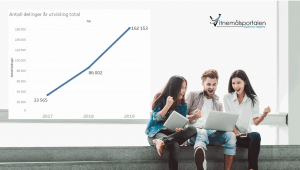
The Norwegian Diploma Registry (Vitnemålsportalen) has seen a large increase in sharing of educational results via EMREX in the last years. The number of EMREX sharing doubled from 2019 to 2020, from 28 000 to 57 000. The reason for this has been the growing number of web services connecting as EMREX clients to the Diploma Registry in the last couple of years, especially recruitment services. Regular sharing of higher educational results are also on a steady rise, with 71 000 in 2018, 133 000 in 2019 and 164 000 in 2020. The Diploma registry is a Norwegian service established in 2017 by Unit – The Norwegian Directorate for ICT and Joint Services in Higher Education and Research, commissioned by the Norwegian Ministry of Education and Research. The main goal of the Diploma Registry is to help individuals collect their results from higher education and share them with potential employers, educational institutions and other relevant recipients. The sharing is easy, safe and 100% digital. The use of the Diploma Registry is free of charge. Since 2017 logins have nearly doubled year after year, with almost 600 000 in 2020. The Diploma Registry is now an established resource among the whole of the population, not only young people in an ongoing education. Unit is in the process of expanding the scope of the service with other kinds of education, knowledge and skills, e.g. vocational schools, professional certificates, language tests, driver’s licences and more. More information about the service can be found at https://www.vitnemalsportalen.no/english/

Norwegian Diploma Registry (Vitnemålsportalen)

Norwegian Home Builders’ Association wants to use EMREX

Unit manages the Norwegian Diploma registry – Vitnemålsportalen – which is the Norwegian node in the EMREX network.   Cooperation between Unit – the Directorate for ICT and joint services in higher education and research, and Norwegian Home Builders’ Association has been initiated to support the digitalization of the HSE (Health, Security, and Environment) Card. All those who carry out work on building and construction sites, including both Norwegian and foreign workers, must have an HSE card. To produce these cards, a lot of manual labour is involved, and the input is mostly paper based. The goal is to automate this process. Among the information needed to set up an HSE card is documentation of credentials from education, which is data already included in Vitnemålsportalen. Addition information like results of recognition, driver’s licences, licences to run heavy machinery, documentation of skills and more is needed. As part of this cooperation, Unit wants to provide this kind of data in Vitnemålsportalen, enable the owner of the data (the citizens themselves) to share the data with third parties like the home builders. This is also some of the background for the work started in EMREX to add additional data types to ELMO. Unit hopes more organizations will join the work to describe the need for additional information. The work already done by Europass in providing support for entitlement as part of the EDCI format will be good input to this task.

Workshop for members of 4EU+ Alliance

On January 26, 2021 the University of Warsaw organized a workshop for partner universities, members of 4EU+ Alliance. The main goal of the meeting was to decide how to make mobility data exchange between 4EU+ partners as easy as possible. European Commission’s European Student Card Initiative requires HEIs to exchange more data digitally and to make information more accessible to students. HEIs are expected to use the Erasmus Without Paper infrastructure to exchange data. By 2022 it will be compulsory to exchange inter-institutional agreements digitally. Increased number of student mobilities and virtual mobilities will significantly increase the number of transcripts that will have to be issued and sent to students/partner HEIs. Therefore, it is essential to simplify the process and to lessen the burden on IROs/Student Offices or other units issuing transcripts. One possible solution is EMREX. “The purpose of EMREX, with its electronic data exchange solution, is to empower individuals to control their own student data and exchange throughout lifespan, across borders for various purposes.” During the meeting EMREX has been presented in detail:

  • Presentation by Janina Mincer-Daszkiewicz.
  • Recording (embedded in the EMREX portal) by Janina Mincer-Daszkiewicz.

Technical workshop on changes in ELMO and EMREG

On January 29 over 30 attendants from 15 countries gathered online to discuss need for changes in the ELMO format, further cooperation with other organizations and needs for converters between different formats. Furthermore, a suggestion how to make the EMREX registry more robust and easier to maintain was presented. EMREG is a centralized service that has to be available to all SMPs. It gives a list of all available NCPs, as well as other information necessary to establish communication with each of them. A proposal was presented for the registry model including technical and policy issues.

Original Architecture of the EMREX Registry 

Target architecture of the EMREX Registry

Work with ELMO standard was also discussed. We have already enabled digitally signed diplomas and micro credentials to the existing structured ELMO data. EMREX is also cooperating with Enic-Naric organization within the new DigiNet project (Erasmus+). To do this, ELMO needs to be upgraded to process results of recognition. Another important task brought up at the workshop was to move forward with exploring the relation between ELMO and Europass Digital Credentials Infrastructure (EDCI). When EDCI was designed, Europass did align this to the ELMO format. https://github.com/european-commission-europass/Europass-Learning-Model. We will bring up concrete examples of mapping between ELMO and EDCI, to ensure there will be no loss of information when converting data from ELMO to EDCI. Any findings of missing data from this exercise will be brought forward to Europass as a change proposal for EDCI. This work may lead to setting up converters to enable automatic data exchange from ELMO to EDCI, and vice versa.

Webinar “World’s smoothest cross-border mobility and daily life through digitalization”

Finland is holding the presidency on Nordic Council of Ministers this year. They are going to launch a project “World’s smoothest cross-border mobility and daily life through digitalization“. One part of the project is called “Studying in other Nordic countries and the three Baltic countries” and the National Agency for Education in Finland will be in charge of this project. The goal is to promote especially secondary school data transfer. In the kick-off webinar EMREX was presented as a possible solution to transfer data. More information can be found at https://vm.fi/en/-/finland-to-promote-digitalisation-during-its-2021-presidency-of-nordic-council-of-ministers.  The kick-off webinar was held in February 2021.

Single Digital Gateway

According to the introductory information which can be found at the SDG web page https://ec.europa.eu/growth/single-market/single-digital-gateway_en: The single digital gateway will facilitate online access to the information, administrative procedures and assistance services that citizens and businesses need to get active in another EU country. By the end of 2020, citizens and companies moving across EU borders will easily be able to find out what rules and assistance services apply in their new residency. By the end of 2023 at the latest, they will be able to perform a number of procedures in all EU member states without any physical paperwork, like registering a car or claiming pension benefits The relation to the activities in Single Digital Gateway (SDG), when it comes to credential data, should be explored. SDG has activities in the area of education, to support the following types of evidence:

  • Evidence of completion of secondary education.
  • Tertiary education diploma evidence.
  • Tertiary education diploma supplement evidence.

Github repository for SDG sandbox is available at https://github.com/SEMICeu/SDG-sandbox. The data sources for EWP, EMREX and Europass Digital Credentials are the same as for SDG when it comes to Tertiary education diploma evidence and Tertiary education diploma supplement evidence. For EMREX and Europass this is also the case for Evidence of completion of secondary education. To ensure a successful outcome of all these EU initiatives, they should be connected to discuss models and standards for exchanging this information.

Vietsch project

The EMREX project funded by the Vietsch foundation is well on its way. The first part of the project “Industrializing the EMREX Registry and reviewing the ELMO standard” was finished earlier this year and the project group has reported the activities and results to the Vietsch foundation. The special circumstances with COVID-19 is making especially dissemination work more challenging but, regardless, also the second part of the project is also proceeding. Additional information about the project and its advancement can be found here: https://www.vietsch-foundation.org/2020/08/05/emrex-project/.

Policy Group to support the EMREX work

According to the EMREX statutes the EMREX Executive Committee has the right to appoint a Policy Group (PG) to support EMREX work. The responsibility of the PG is to provide policy expertise to support the EMREX EC and EMREX work in general. The members of the PG may be invited to participate in EC meetings but they don’t have a vote in the meetings. As the first member of the Policy Group the EMREX EC has appointed Guido Bacharach from Stiftung für Hochschulzulassung, Germany. Welcome, Guido!

Get in touch

EMREX portal is available at emrex.eu. To contact us write to info@emrex.eu.  To get support write to support@emrex.eu.